Skip to content
+90 552 566 26 66WhatsAppinfo@frostech.co
Plan your storeLoad your containerCooling loadRefrigeration AcademyTrack shipment
FROSTECH
Products
FROSTECH FRENIX – Island freezers & chillersFRENIXIsland freezers & chillersFROSTECH VELIX – No-Frost island freezersVELIXNo-Frost island freezersFROSTECH NORDIX – Top-mounted glass-door unitsNORDIXTop-mounted glass-door unitsFROSTECH CRYOIX – Plug-in multideck cabinetsCRYOIXPlug-in multideck cabinetsFROSTECH LUMIX – Upright glass-door cabinetsLUMIXUpright glass-door cabinetsFROSTECH CRIO – Plug-in glass-door cabinetsCRIOPlug-in glass-door cabinetsFROSTECH SOVA – Remote serve-over countersSOVARemote serve-over countersFROSTECH ALPI – Remote glass-door freezersALPIRemote glass-door freezersFROSTECH FREXO – Remote multidecksFREXORemote multidecksFROSTECH POLA – Remote glass-door multidecksPOLARemote glass-door multidecks
Tools:Store plannerTrack shipment3D container loaderCooling load calculatorLine-up builderCompare modelsBecome a distributor
View all products →
Spare PartsAbout UsCatalogues & DownloadsTechnical SupportContact
EN
ENEnglishTRTürkçeARالعربيةRUРусскийFRFrançaisDEDeutschESEspañolHEעברית
0 Request a Quote
Home / Blog
31.10.2026 · 4 min read

Types of Refrigerants Used in Commercial Refrigeration

A practical guide to refrigerant families, GWP and ODP, safety classes and the F-gas phase-down, and how to choose a refrigerant for display cabinets.

Types of Refrigerants Used in Commercial Refrigeration

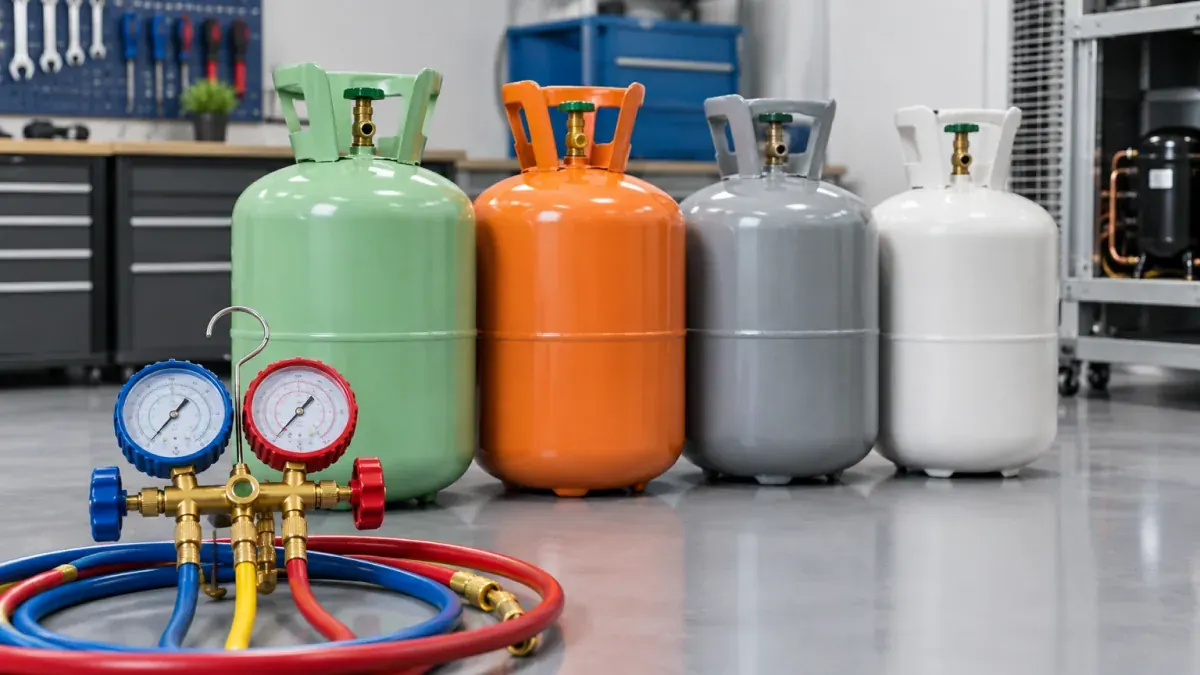
The refrigerant is the working fluid that carries heat out of a display cabinet. It boils in the evaporator, absorbing heat from the products, and condenses in the condenser, releasing that heat elsewhere. The choice of refrigerant affects efficiency, safety, servicing, legal compliance and the long-term cost of owning the equipment. This article explains the main refrigerant families, the environmental and safety ratings you will see on a data sheet, and what to consider when choosing.

Refrigerant families: from CFCs to natural refrigerants

Refrigerants are usually grouped by chemical family:

  • CFCs (chlorofluorocarbons), such as R12 and R502. They damage the ozone layer and were phased out under the Montreal Protocol.
  • HCFCs (hydrochlorofluorocarbons), such as R22. Less damaging to ozone than CFCs, but still ozone-depleting, and also phased out in most markets.
  • HFCs (hydrofluorocarbons), such as R134a and R404A. They do not deplete ozone, but many have a high global warming potential.
  • HFC/HFO blends and HFOs (hydrofluoro-olefins), such as R449A (a blend) and R1234yf or R1234ze (pure HFOs). They were developed to lower the climate impact of HFCs.
  • Natural refrigerants: hydrocarbons such as R290 (propane) and R600a (isobutane), R744 (carbon dioxide) and R717 (ammonia).

Common refrigerants in supermarket equipment

R134a was widely used in medium-temperature plug-in units and bottle coolers. R404A was for many years the standard for low-temperature cabinets and remote systems, but its very high GWP has made it a target of phase-down rules. R449A is one of the lower-GWP blends used to replace R404A in existing and new remote systems.

R290 and R600a are now common in plug-in cabinets. They have very low GWP and good thermodynamic properties, which often allows smaller compressors and good efficiency. Because they are flammable, the charge per circuit is limited by safety standards and the equipment must be designed with suitable electrical components. R744 (CO2) is used in transcritical and cascade systems for larger stores; it is non-flammable but operates at very high pressures. R717 (ammonia) is highly efficient but toxic, and is mainly found in industrial refrigeration and large cold stores rather than in retail display cabinets.

GWP and ODP explained

ODP (ozone depletion potential) measures how much a substance damages the ozone layer compared with R11, which has an ODP of 1. Modern HFCs, HFOs and natural refrigerants have an ODP of zero.

GWP (global warming potential) compares the warming effect of a refrigerant leaked into the atmosphere with the same mass of CO2 over a set period, usually 100 years. R404A has a GWP of several thousand; R134a is above one thousand; R290 and R600a are in single figures; R744 has a GWP of 1 by definition.

F-gas rules and the Kigali Amendment

The EU F-gas Regulation limits the quantity of HFCs that can be placed on the market and bans high-GWP refrigerants in certain types of new equipment, including many commercial refrigeration applications. The Kigali Amendment to the Montreal Protocol extends a gradual HFC phase-down to countries worldwide, on different timetables. In practice, high-GWP refrigerants are becoming more expensive and harder to obtain, which is an important factor when buying equipment expected to last ten years or more.

Safety classes: A1, A2L and A3

Standards such as ISO 817 and EN 378 classify refrigerants by toxicity (A = lower, B = higher) and flammability (1 = no flame propagation, 2L = lower flammability, 2 = flammable, 3 = higher flammability):

  • A1: R134a, R404A, R449A, R744.
  • A2L: HFOs such as R1234yf and R1234ze, and some blends.
  • A3: R290 and R600a.
  • B2L: R717 (ammonia).

The class determines charge limits, installation rules and the training technicians need.

How to choose

For new plug-in cabinets, hydrocarbons are usually the most future-proof option. For central systems, the choice is often between CO2 and lower-GWP synthetic blends, depending on store size, climate and the skills of local service companies. Always check local regulations, the availability of trained technicians and spare parts, and the expected life of the installation.

When comparing cabinets, look for the refrigerant type and charge on the data plate and specification sheet. FROSTECH plug-in models use R290, with some using R600a, while remote models connect to the store's central system; the refrigerant is stated in each model's technical data.
Start a request ← All articles

Home / Blog
31.10.2026 · 3 min read

Types of Refrigeration Compressors

Reciprocating, rotary, scroll and screw compressors compared, with typical applications and the role of inverter variable-speed compressors.

Types of Refrigeration Compressors

The compressor drives the refrigeration system, and several designs exist to suit different capacities, refrigerants and duties. A small bottle cooler, a supermarket multideck and a central plant room each use different types. Knowing the main families helps when you read a specification sheet or discuss a project with a contractor.

Reciprocating compressors

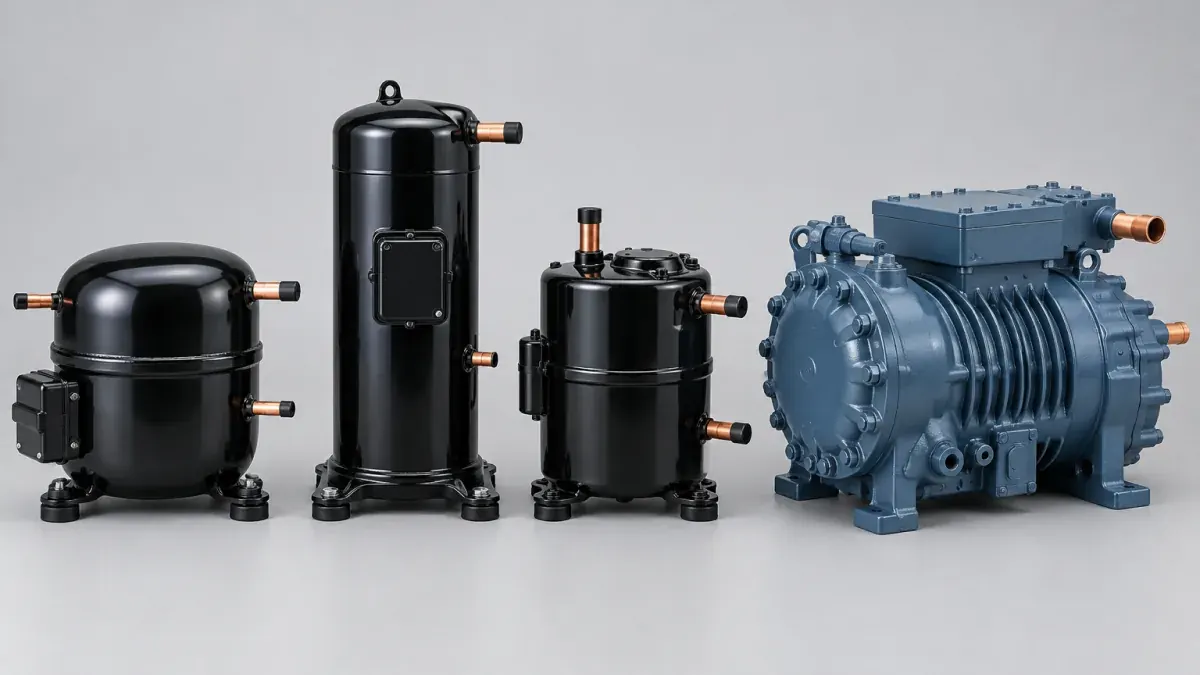
A reciprocating compressor uses pistons moving in cylinders, driven by a crankshaft. Suction and discharge valves (usually reed valves) control the flow of refrigerant. It is the most widely used type in commercial refrigeration and comes in three constructions:

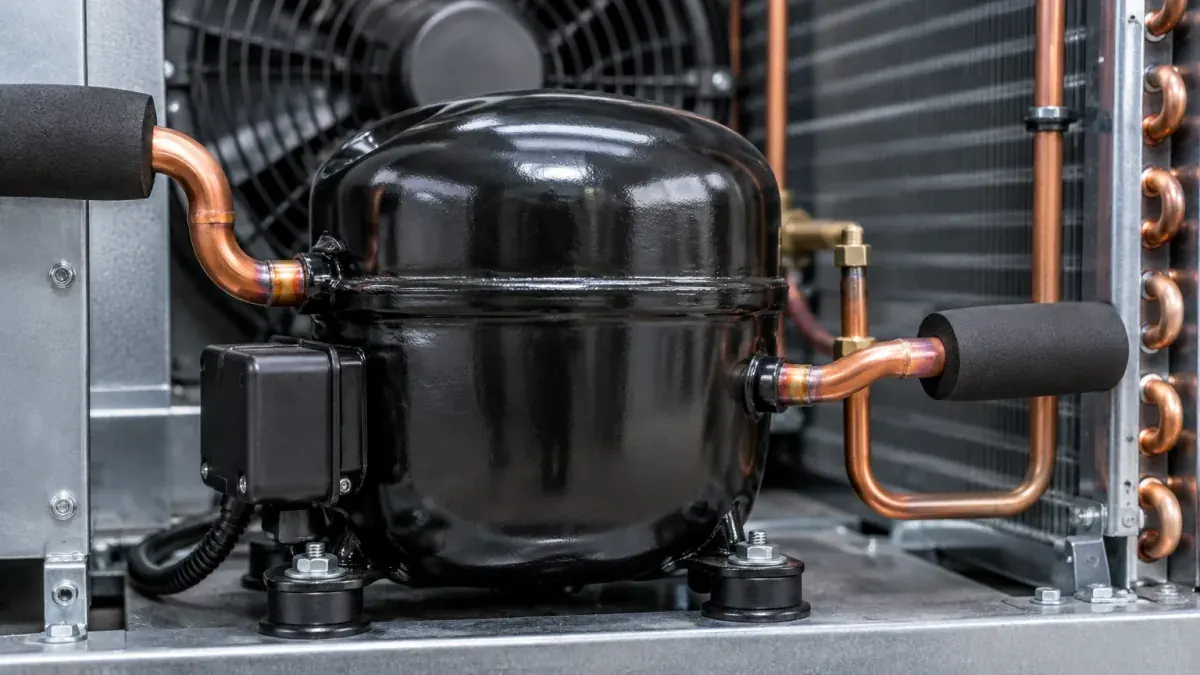
  • Hermetic: motor and compressor are sealed in a welded steel shell. Compact, quiet and inexpensive, they are standard in plug-in display cabinets and small condensing units. They cannot be repaired internally; a failed unit is replaced.
  • Semi-hermetic: motor and compressor share a bolted housing that can be opened for repair of valves, bearings or the motor. They are common in larger condensing units and compressor racks.
  • Open: the motor is outside the compressor and drives it through a shaft and seal, often by belt or coupling. Today they are mainly used in industrial and ammonia systems.

Rotary, scroll and screw compressors

Rotary compressors

Rotary compressors compress refrigerant using a rolling piston or rotating vanes inside a cylinder. They have few moving parts, are compact and run smoothly. They are common in air conditioning and some small refrigeration appliances, but they are less often used for low-temperature commercial duty.

Scroll compressors

A scroll compressor has two interleaved spiral scrolls: one fixed and one orbiting. Pockets of gas are trapped and progressively squeezed towards the centre, where they are discharged. Scrolls have no suction or discharge reed valves, few moving parts and low vibration. They tolerate small amounts of liquid better than reciprocating compressors and are widely used in medium-sized condensing units, racks and heat pumps. Vapour-injection versions improve performance at low evaporating temperatures.

Screw compressors

Screw compressors use one or two helical rotors to compress the gas continuously. They suit large capacities and are used in industrial refrigeration, large cold stores and some central supermarket plants. Capacity is often controlled by a slide valve or by variable speed. They generally need oil separation and oil management systems.

Inverter and variable-speed compressors

A fixed-speed compressor runs at full capacity and switches on and off to hold temperature. A variable-speed compressor, driven by an inverter, adjusts its speed to match the actual load. This gives several benefits:

  • more stable cabinet temperatures, with less swing between cut-in and cut-out;
  • fewer start-stop cycles, reducing wear and electrical stress;
  • better efficiency at part load, which is how most cabinets operate for most of the day;
  • lower noise at reduced speed.

The trade-offs are higher purchase cost, the need for a compatible controller and drive, and more complex diagnostics.

Pros and cons at a glance

  • Hermetic reciprocating: low cost and compact, but not repairable and less efficient at large sizes.
  • Semi-hermetic reciprocating: repairable and robust, but heavier and more expensive.
  • Rotary: compact and smooth, but limited range for low-temperature duty.
  • Scroll: efficient, quiet and reliable, but not repairable and less suited to very small capacities.
  • Screw: high capacity and continuous flow, but costly and suited mainly to large plants.

For a plug-in display cabinet, the compressor is normally a hermetic reciprocating or variable-speed unit selected by the manufacturer for the cabinet's load and refrigerant. For remote systems, the choice is made at plant level. In both cases, check the compressor type, refrigerant and operating envelope in the technical data, and make sure local technicians can support it.

Start a request ← All articles

Home / Blog
30.10.2026 · 4 min read

What Does the Compressor Do?

How the compressor raises refrigerant pressure and temperature, why it must never take in liquid, warning signs of failure and the protection devices fitted.

What Does the Compressor Do?

The compressor is often called the heart of a refrigeration system. It keeps refrigerant circulating and creates the pressure difference that allows heat to be absorbed inside the cabinet and released outside it. Understanding what it does, and what harms it, helps owners recognise problems early and protects one of the most expensive parts of the equipment.

Raising pressure and temperature

Refrigerant leaves the evaporator as a low-pressure, low-temperature vapour that has absorbed heat from the cabinet. The compressor draws in this vapour and compresses it. As the pressure rises, so does the temperature, so the refrigerant leaves the compressor as a hot, high-pressure vapour.

This step is essential. Heat only flows from a warmer place to a cooler one. By raising the refrigerant temperature above the temperature of the surrounding air (or water), the compressor makes it possible for the condenser to reject the heat. Without compression, the heat picked up in the cabinet would have nowhere to go.

Suction side and discharge side

The compressor divides the system into two halves:

  • Suction (low side): the pipe from the evaporator to the compressor inlet carries cool, low-pressure vapour. The suction line is often insulated.
  • Discharge (high side): the pipe from the compressor outlet to the condenser carries hot, high-pressure vapour. The discharge line can be hot enough to burn skin.

Technicians read pressures on both sides to judge how the system is working. The ratio between discharge and suction pressure (the compression ratio) affects efficiency and compressor temperature: the higher the ratio, the harder the compressor works.

Why the compressor must never take liquid

A compressor is designed to compress vapour. Liquid is practically incompressible. If liquid refrigerant or a large amount of oil reaches the cylinders, the result is slugging: hydraulic shock that can break valves, connecting rods or pistons. Liquid can also wash oil off bearings and dilute the oil in the crankcase, causing wear.

Common causes of liquid return (floodback) include:

  • low superheat caused by an incorrectly set or faulty expansion valve;
  • a blocked or iced evaporator, or a failed evaporator fan, so the refrigerant cannot fully evaporate;
  • refrigerant overcharge;
  • refrigerant migrating to the compressor during long off periods, especially in cold conditions.

Designers use correct superheat control, suction accumulators, crankcase heaters and pump-down cycles to prevent it.

Signs of a failing compressor

Owners cannot test a compressor internally, but certain symptoms are worth reporting to a technician promptly:

  • the cabinet gradually loses temperature while the compressor runs continuously;
  • the compressor hums but does not start, or trips repeatedly;
  • knocking, rattling or unusually loud operation;
  • the circuit breaker trips when the compressor starts;
  • the compressor body is much hotter than normal, or there is a burnt smell;
  • oil stains around pipe joints near the compressor, which may indicate a leak.

Protection devices

Small hermetic compressors are fitted with several protective and starting components:

  • Thermal overload protector: switches the compressor off if the motor current or temperature becomes too high, then resets once it has cooled.
  • Start relay (current, voltage or PTC type): connects the start winding briefly to get the motor turning.
  • Start capacitor and run capacitor: provide the starting torque and improve running efficiency on some motors.
  • High- and low-pressure switches: stop the compressor if pressures go outside safe limits, for example because of a blocked condenser or loss of refrigerant.

Most compressor failures are caused by system problems rather than by the compressor itself. Keeping the condenser clean, the evaporator free of ice and airflow unobstructed does more to protect the compressor than anything else. When choosing commercial refrigeration equipment, look for appropriate protection, accessible service points and a controller that records alarms, so faults are caught before they damage the compressor.

Start a request ← All articles

Home / Blog
30.10.2026 · 4 min read

The Refrigeration Cycle Explained Simply

A plain-language walk through the vapour-compression cycle: evaporator, compressor, condenser and expansion device, with superheat and subcooling basics.

The Refrigeration Cycle Explained Simply

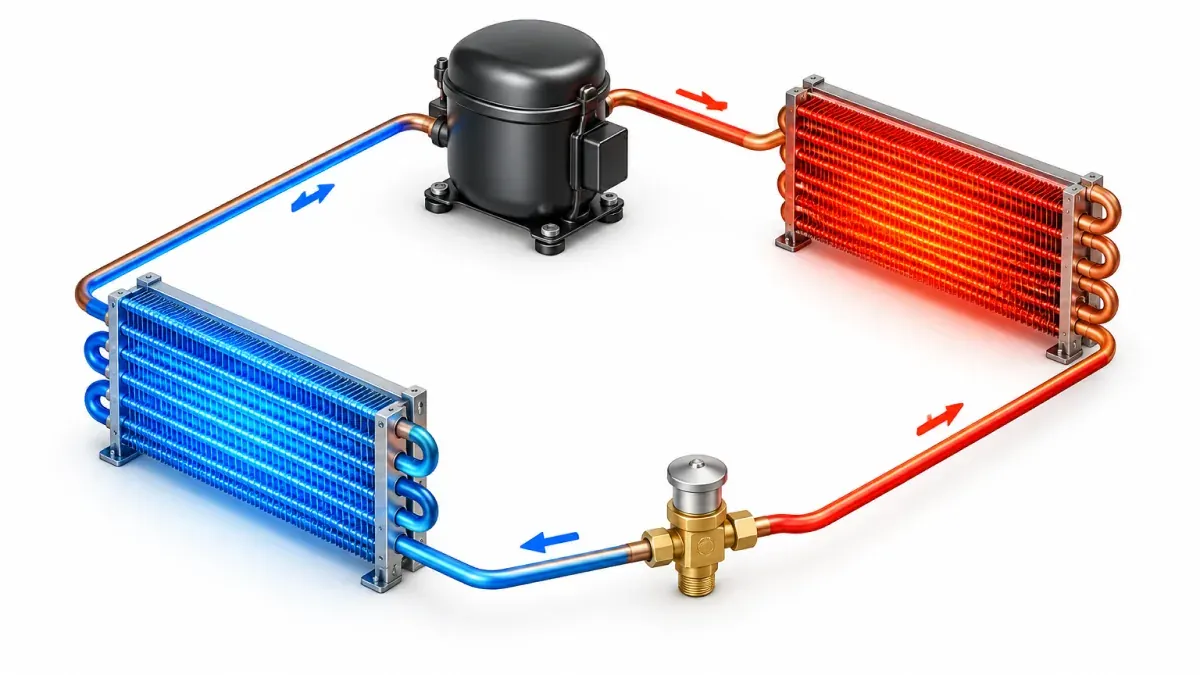
Almost every commercial display cabinet, cold room and air conditioner works on the same principle: the vapour-compression cycle. A refrigerant circulates in a closed loop, changing from liquid to vapour and back again. Each change of state moves heat. Once you understand the four main stages, most of what technicians talk about becomes much easier to follow.

The key idea: boiling absorbs heat

When a liquid boils it absorbs a large amount of heat without its temperature rising, and when a vapour condenses it releases that heat. The temperature at which a refrigerant boils depends on its pressure: at low pressure it boils at a low temperature, and at high pressure it condenses at a high temperature. The refrigeration cycle uses this by keeping the refrigerant at low pressure inside the cabinet and at high pressure outside it.

The four stages

  1. Evaporator: low-pressure liquid refrigerant enters the evaporator coil inside the cabinet. It boils at a temperature below the cabinet air, absorbing heat from the air and the products. It leaves as a low-pressure vapour.
  2. Compressor: the compressor draws in this vapour and compresses it, raising its pressure and temperature. The refrigerant leaves as a hot, high-pressure vapour.
  3. Condenser: the hot vapour passes through the condenser, where air or water carries heat away. The refrigerant cools, condenses into liquid and leaves as a high-pressure liquid.
  4. Expansion device: the high-pressure liquid passes through a capillary tube or expansion valve, which creates a sharp pressure drop. Some of the liquid flashes to vapour, cooling the rest, and cold low-pressure refrigerant enters the evaporator again.

The heat rejected at the condenser equals the heat absorbed in the evaporator plus the energy added by the compressor. That is why a plug-in cabinet releases more heat into the shop than it removes from its products.

Low side and high side

The compressor and the expansion device divide the system into two pressure zones:

  • Low side: from the outlet of the expansion device, through the evaporator, to the compressor suction. Low pressure, low temperature.
  • High side: from the compressor discharge, through the condenser and liquid line, to the inlet of the expansion device. High pressure, high temperature.

Technicians measure the pressure on each side and convert it to the corresponding saturation temperature to check how the system is performing.

Superheat and subcooling

Two measurements tell a technician a great deal about the cycle:

  • Superheat is how much warmer the suction vapour is than its boiling (saturation) temperature. A small, controlled superheat shows that all the liquid has evaporated before reaching the compressor, protecting it from liquid. Too much superheat means the evaporator is starved of refrigerant and cooling capacity is lost.
  • Subcooling is how much cooler the liquid leaving the condenser is than its condensing temperature. Adequate subcooling ensures that only liquid, without vapour bubbles, reaches the expansion device, so it can meter refrigerant correctly.

Abnormal superheat or subcooling can point to undercharge, overcharge, restrictions, a faulty expansion valve or a dirty condenser. Measuring them requires gauges, accurate thermometers and refrigerant training, so this is work for a qualified technician.

Why it matters for owners

The cycle only works well if each stage can do its job. The evaporator needs clean coils and good airflow; the condenser needs clean fins and access to cool air; the compressor needs vapour, not liquid; and the expansion device needs the correct refrigerant charge. When choosing and using commercial refrigeration equipment, simple habits such as keeping the condenser clean and not blocking air grilles support every stage of the cycle and keep running costs down.

Start a request ← All articles

Home / Blog
29.10.2026 · 4 min read

The Main Parts of a Refrigeration System

A clear overview of each major component in a refrigeration system, from compressor and condenser to filter drier, sight glass, controller and insulation.

The Main Parts of a Refrigeration System

A refrigeration system is more than a compressor and two coils. Display cabinets and cold rooms include a range of components that protect the system, control it and help technicians maintain it. This overview gives a short description of each main part and its role, so that specification sheets and service reports are easier to understand.

The four essential components

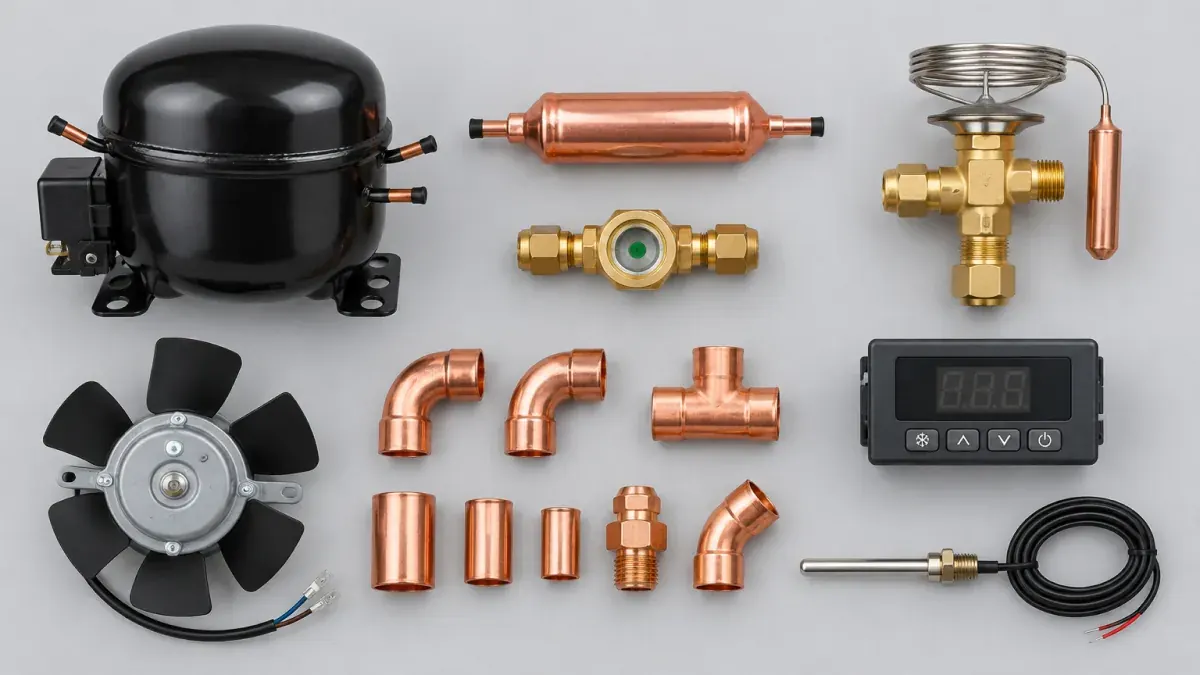
  • Compressor: draws in low-pressure refrigerant vapour from the evaporator and compresses it to a high pressure and temperature, keeping refrigerant circulating.
  • Condenser: a heat exchanger that rejects heat from the hot refrigerant vapour to air or water, condensing it into liquid.
  • Expansion device: a capillary tube or expansion valve that reduces the pressure of the liquid and meters the flow into the evaporator.
  • Evaporator: a heat exchanger inside the cabinet where refrigerant boils and absorbs heat from the air and products.

Components on the refrigerant circuit

  • Filter drier: installed in the liquid line, it removes moisture and particles that could freeze in the expansion device or cause acid formation. It should be replaced whenever the circuit is opened.
  • Sight glass: a small window in the liquid line that shows whether liquid flow is full and free of bubbles. Many sight glasses also include a moisture indicator that changes colour.
  • Liquid receiver: a vessel after the condenser that stores liquid refrigerant, allowing for changes in load and holding the charge during service. Common in remote systems and systems with expansion valves.
  • Suction accumulator: a vessel in the suction line that traps liquid refrigerant and oil, protecting the compressor from liquid return, particularly after defrost.
  • Oil separator: used in larger systems to return oil from the discharge gas to the compressor.
  • Valves: solenoid valves, check valves, service valves and pressure regulators that control, isolate or protect parts of the circuit.

Fans, controls and sensors

Fans and air movement

  • Condenser fan: draws air across the condenser coil to carry heat away.
  • Evaporator fan: circulates cabinet air through the evaporator and, in open multidecks, creates the air curtain across the front.

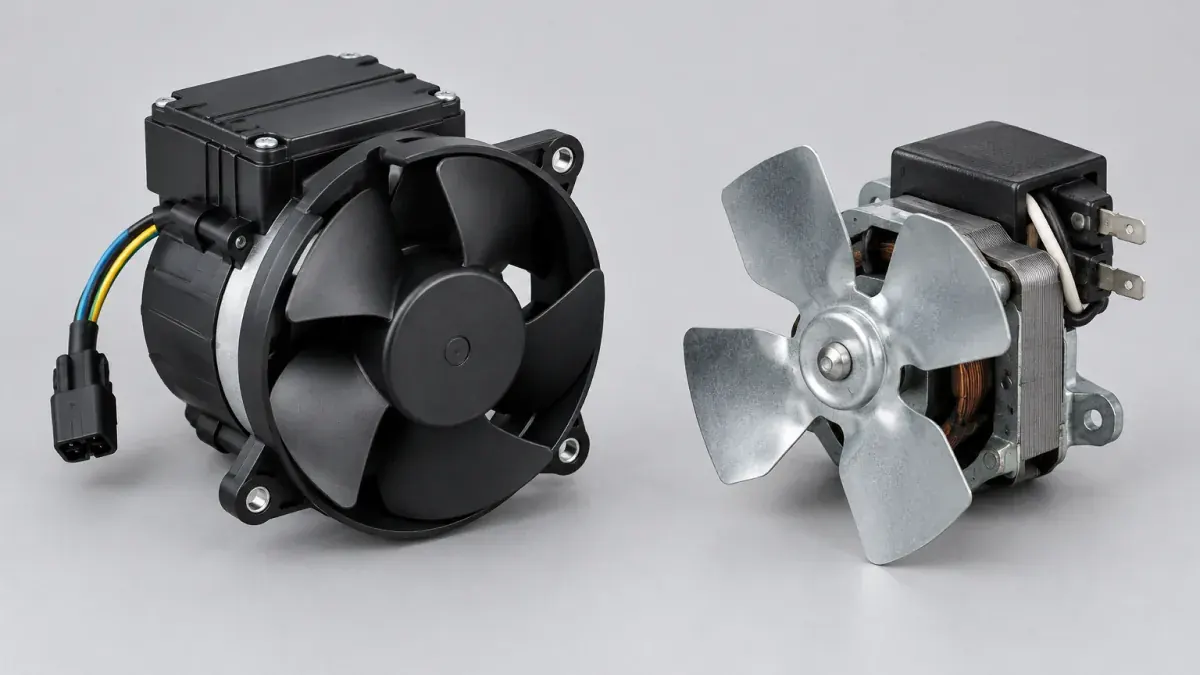
Fans may use shaded-pole motors or more efficient electronically commutated (EC) motors.

Control and sensing

  • Controller or thermostat: switches the compressor, fans and defrost to hold the setpoint, and raises alarms when temperatures are out of range.
  • Air temperature probe: measures cabinet air temperature, usually in the return or discharge air.
  • Evaporator probe: measures coil temperature to end defrost at the right moment and delay fan start-up.
  • Pressure switches and transducers: protect the system against abnormal pressures and, in electronic systems, provide data for control.
  • Defrost heaters: in electric defrost systems, they melt frost from the evaporator.
  • Drain heaters and evaporation tray: keep the drain free of ice and evaporate defrost water in plug-in units.

Piping and insulation

  • Copper or aluminium piping: connects the components. Correct sizing keeps pressure drops low and returns oil to the compressor.
  • Pipe insulation: on suction lines, it prevents heat gain and condensation dripping.
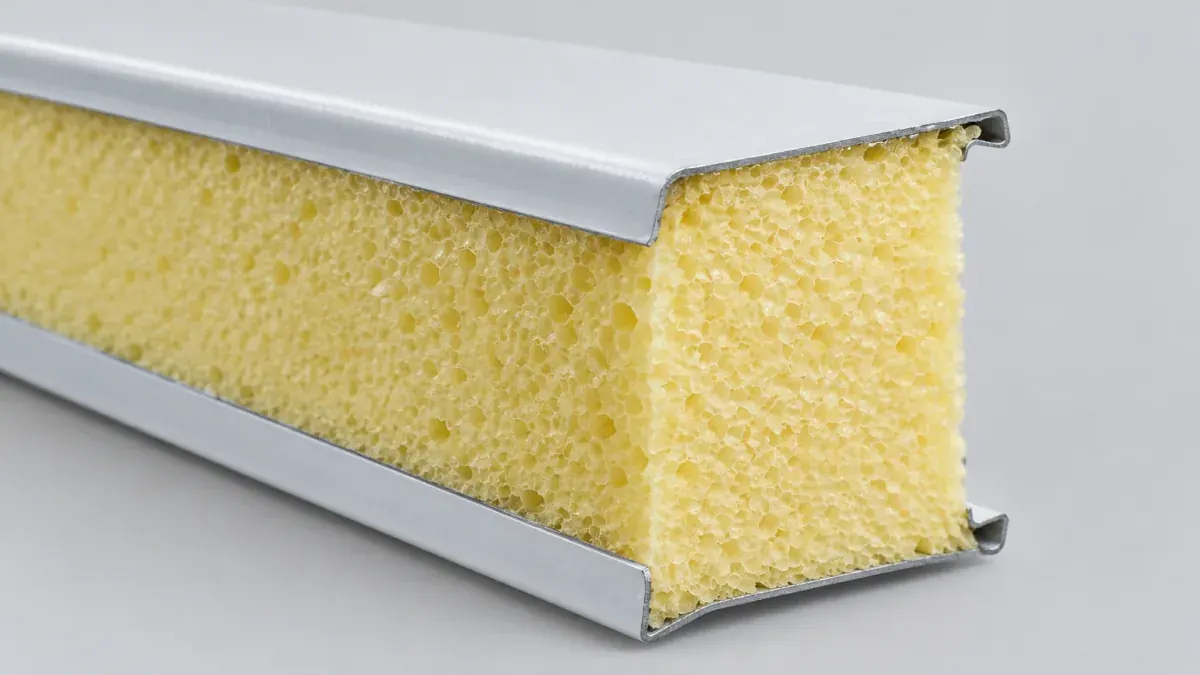
  • Cabinet insulation: polyurethane foam in the walls and base keeps heat out of the cabinet and prevents condensation on the outer surfaces.
  • Doors, glazing and gaskets: on closed cabinets, they keep warm, humid store air out.

Bringing it together

Each part depends on the others. A blocked filter drier starves the evaporator, a dirty condenser raises compressor load, and a faulty probe can stop defrost from working. When choosing commercial refrigeration equipment, look at the quality of these supporting components as well as the compressor, and check that service points, fans and controllers are accessible for maintenance.

Start a request ← All articles

Home / Blog
29.10.2026 · 4 min read

How Expansion Valves Developed: From Capillary Tube to Electronic Valves

The evolution of refrigerant expansion devices, from fixed capillary tubes to thermostatic and electronic expansion valves, and where each is used.

How Expansion Valves Developed: From Capillary Tube to Electronic Valves

The expansion device is a small component with a big job. It drops the refrigerant from high pressure to low pressure and controls how much refrigerant enters the evaporator. Too little and the evaporator is starved; too much and liquid can reach the compressor. Over the decades, expansion devices have evolved from simple fixed restrictions to precise, electronically controlled valves.

Capillary tube

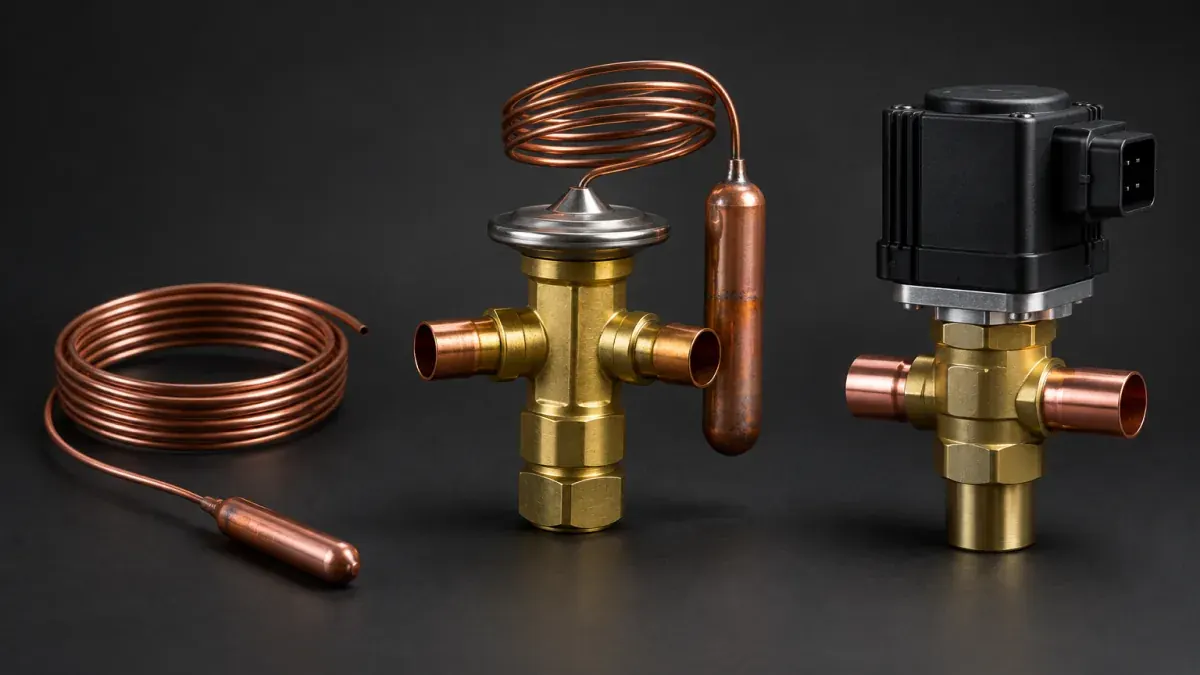
The capillary tube is a long, narrow copper tube, often coiled, between the condenser and the evaporator. Its length and internal diameter create a fixed resistance to flow. It is often soldered alongside the suction line to form a heat exchanger, which improves efficiency.

  • Advantages: no moving parts, very low cost, reliable, and pressures equalise during the off cycle, so the compressor can start against low pressure with a simple motor.
  • Limitations: it cannot adjust to changes in load or ambient temperature, it is sensitive to the exact refrigerant charge, and it can be blocked by moisture or debris.

Capillary tubes remain standard in domestic appliances and many small plug-in cabinets, where loads are relatively stable and charges are small, as with hydrocarbon systems.

Automatic (constant-pressure) expansion valve

The automatic expansion valve (AXV) was an early improvement. It uses a diaphragm and spring to hold a constant evaporator pressure. This works when the load is steady, but when the load rises the valve actually reduces flow, which is the opposite of what is needed. For this reason AXVs are now rare in commercial refrigeration.

Thermostatic expansion valve (TXV)

The thermostatic expansion valve became the standard for commercial systems because it controls superheat rather than pressure. A sensing bulb is clamped to the suction line at the evaporator outlet. The bulb contains a charge that responds to temperature and pushes on a diaphragm in the valve, against the evaporator pressure and an adjustable spring.

  • If the suction line warms (high superheat), the valve opens to feed more refrigerant.
  • If the suction line cools (low superheat), the valve closes to protect the compressor.

Valves with an external equaliser sense pressure at the evaporator outlet and are used where the coil has a significant pressure drop. TXVs adapt well to changing loads, but they need correct bulb mounting and insulation, careful superheat adjustment, and they respond relatively slowly. They also require a stable condensing pressure, which can prevent the system from benefiting fully from cooler weather.

Electronic expansion valve (EEV)

An electronic expansion valve is opened and closed by a stepper motor (or, in some designs, by pulse-width modulation of a solenoid). A controller reads an evaporating pressure transducer and a suction temperature sensor, calculates superheat and positions the valve accordingly.

  • Superheat is controlled more precisely and can be kept lower, so more of the evaporator surface is used.
  • The valve works over a wider range of condensing pressures, allowing lower head pressure in cool conditions and saving energy.
  • Settings can be changed from the controller, and data can be logged and monitored remotely.
  • The valve can close fully during the off cycle, often removing the need for a separate liquid line solenoid valve.

The disadvantages are cost, the need for a compatible controller and sensors, and dependence on a power supply; many valves include or need a back-up to close on power failure.

Where each is used

  • Capillary tube: small plug-in cabinets, bottle coolers, domestic appliances.
  • TXV: many remote display cabinets, cold rooms and condensing units.
  • EEV: modern supermarket remote systems, CO2 installations, variable-speed systems and projects where energy efficiency and monitoring are priorities.

The right expansion device depends on the size of the system, how much the load varies and how much control is needed. When specifying remote cabinets in particular, check which type of valve is fitted and whether it matches the store's central plant and control system.

Start a request ← All articles

Home / Blog
28.10.2026 · 4 min read

Condensers: Types and Function

How condensers reject heat, the differences between air-cooled, water-cooled and evaporative designs, and why a clean condenser saves energy.

Condensers: Types and Function

Every refrigeration system has to get rid of the heat it removes from the cabinet, plus the energy added by the compressor. That is the job of the condenser. If the condenser cannot reject heat efficiently, pressures rise, the compressor works harder and the cabinet may struggle to hold temperature. Understanding condenser types and their care is one of the easiest ways to improve reliability.

What the condenser does

Hot, high-pressure vapour from the compressor enters the condenser. It first cools to its condensing temperature (desuperheating), then condenses into liquid, and finally cools slightly below the condensing temperature (subcooling). The heat released goes to the surrounding air or to water. The condensing temperature must be higher than the temperature of the cooling medium, so the warmer the air around the condenser, the higher the pressure the compressor must reach.

Types of condenser

Air-cooled condensers

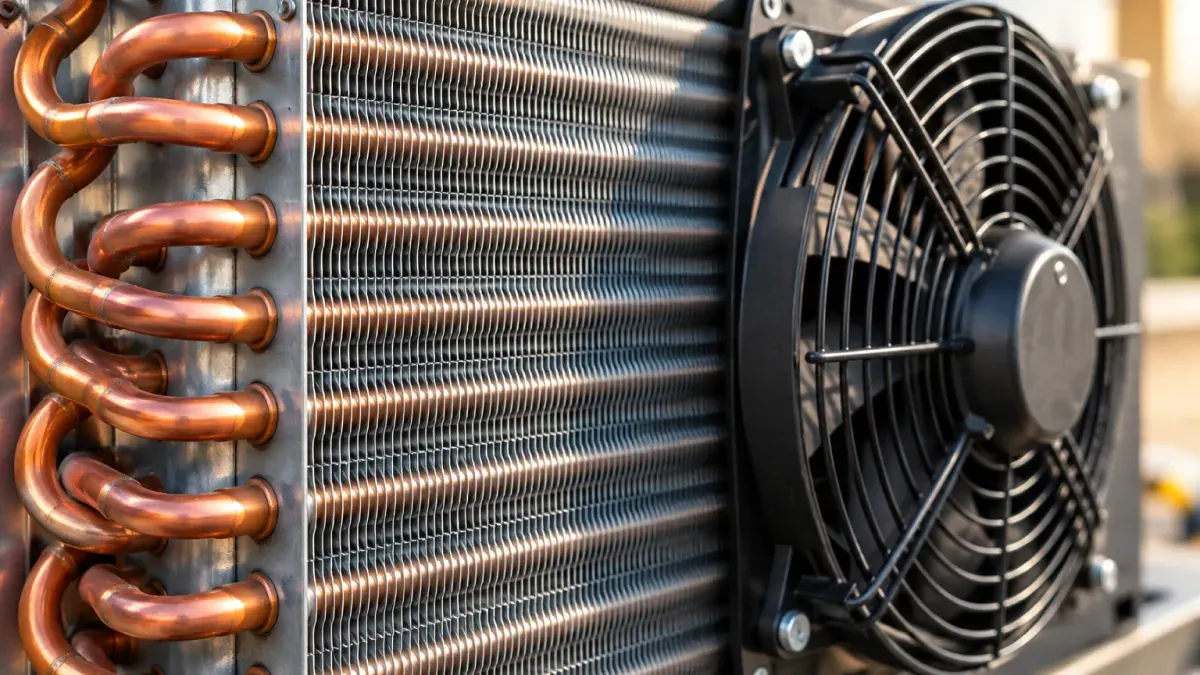
Air-cooled condensers are by far the most common in commercial refrigeration. A fan moves air across a coil. Two main constructions are used:

  • Fin-and-tube: copper tubes with aluminium fins pressed onto them. Robust, easy to repair and widely used.
  • Microchannel: flat aluminium tubes with many small internal channels, brazed to louvred fins. They are compact, light and need a smaller refrigerant charge, which is useful for hydrocarbon systems with charge limits.

Some small cabinets use static (wire-and-tube) condensers on the back, relying on natural convection without a fan.

Water-cooled and evaporative condensers

Water-cooled condensers transfer heat to water, often in a plate or shell-and-tube heat exchanger. The water may come from a cooling tower, a dry cooler or a closed loop. They are compact, quiet in the sales area and allow heat recovery, but they need a water circuit, water treatment and pumps.

Evaporative condensers spray water over the coil while a fan moves air through it. Evaporation of the water gives a lower condensing temperature than dry air alone, improving efficiency, but they require careful water treatment and hygiene management. They are mainly used in large industrial plants.

Plug-in and remote condensing

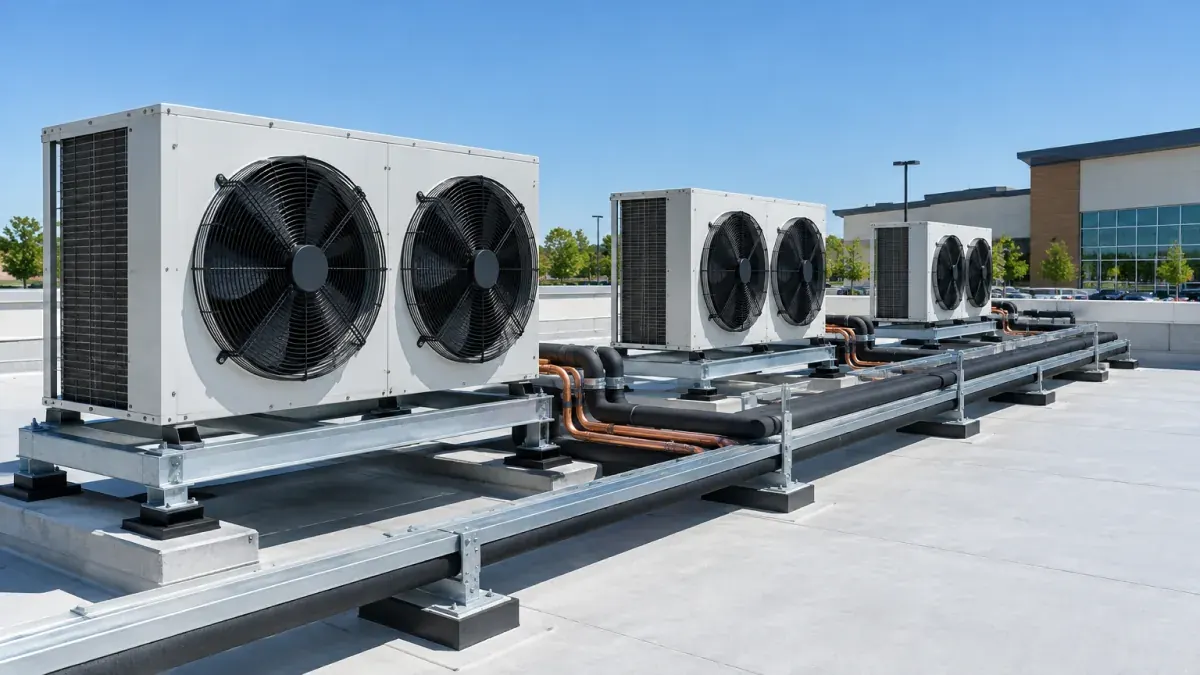
In a plug-in cabinet, the compressor and condenser are built into the cabinet and release heat directly into the store. In a remote system, the cabinet contains only the evaporator and expansion device; refrigerant is piped to a condensing unit or central rack outside the sales area, often with a roof-mounted condenser. Some systems use plug-in cabinets with water-cooled condensers connected to a shared water loop that takes the heat outside.

Cleaning and the cost of a dirty condenser

Air-cooled condensers draw in dust, grease, packaging fibres and lint. A layer of dirt on the fins insulates the coil and blocks airflow. The results are predictable:

  • higher condensing pressure and temperature;
  • higher compressor power consumption and longer running times;
  • reduced cooling capacity, so cabinet temperature may rise in warm periods;
  • higher compressor discharge temperatures, shortening compressor life;
  • high-pressure switch trips in severe cases.

Condensers should be inspected regularly and cleaned with a soft brush or vacuum, or by a technician with suitable tools, following the manufacturer's instructions and with power isolated. Bent fins should be straightened carefully. In dusty locations cleaning may be needed monthly.

Low-maintenance condenser designs

Some manufacturers offer "dust-free" or "maintenance-free" condenser arrangements. In general terms, these use wider fin spacing, static coils, filters, airflow paths that limit dust deposit, or fans that periodically reverse to blow dust out. Such designs reduce how often cleaning is needed, but no condenser is entirely free of care, and inspection should remain part of any maintenance plan.

When choosing equipment, consider where the heat will go, how easy the condenser is to reach and clean, and the ambient conditions in the store. Good access to the condenser is one of the most practical features to look for in a plug-in cabinet.

Start a request ← All articles

Home / Blog
28.10.2026 · 3 min read

What the Evaporator Does

How the evaporator absorbs heat in a display cabinet, the difference between static and ventilated coils, fin spacing, frosting and air curtains.

What the Evaporator Does

The evaporator is where the actual cooling happens. It is the heat exchanger inside the cabinet that takes heat from the air and, through the air, from the products. Its design affects how quickly a cabinet pulls down, how evenly it holds temperature, how often it needs defrosting and how much energy it uses.

How the evaporator absorbs heat

Cold, low-pressure refrigerant from the expansion device enters the evaporator coil as a mixture of liquid and vapour. Because its boiling temperature is below the cabinet air temperature, heat flows from the air into the refrigerant, which boils and leaves as vapour. The difference between the cabinet air temperature and the evaporating temperature (often called the TD) is a key design parameter. A small TD keeps humidity higher and reduces frost but needs a larger coil; a large TD allows a smaller coil but dries products and frosts the coil faster.

Static and ventilated evaporators

Static evaporators rely on natural convection: cold air sinks from the coil and warm air rises towards it. They are found in some chest freezers, serve-over counters for fresh meat and fish, and certain cold wells. Their gentle airflow helps reduce dehydration of unwrapped products, but temperature distribution is less even and pull-down is slower.

Ventilated (fan-assisted) evaporators use one or more fans to force air through the coil. They transfer heat far more effectively, so the coil can be compact, and they distribute cold air throughout the cabinet. Almost all multidecks and glass-door cabinets use ventilated evaporators.

Fin spacing and frosting

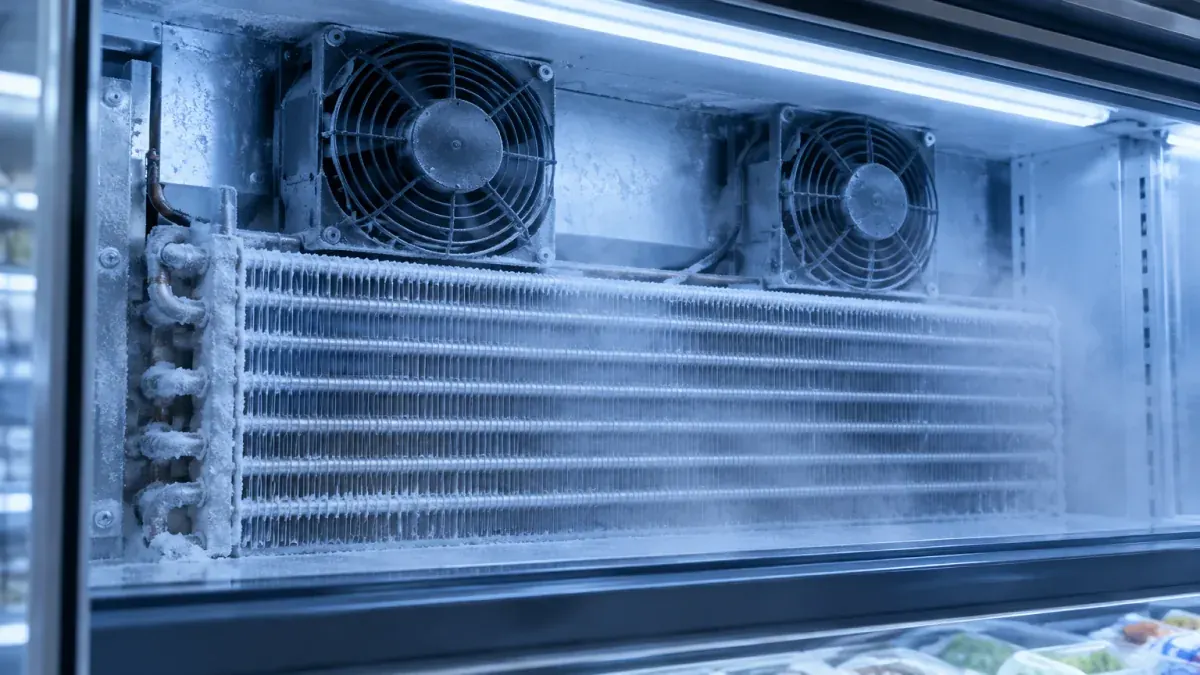
Evaporators use fins to increase the heat transfer surface. When the coil surface is below 0 °C, moisture from the air freezes on it as frost. Frost reduces airflow and acts as insulation, so capacity falls. Fin spacing is chosen to balance compactness against frost tolerance:

  • Medium-temperature cabinets usually have closer fin spacing, as frost build-up is limited and easily removed during off-cycle defrost.
  • Low-temperature cabinets need wider spacing, so that frost can accumulate between defrosts without blocking the coil.
  • Some coils use variable fin spacing, wider at the air inlet where most frost forms.

Airflow and air curtains in open multidecks

In an open multideck, the evaporator fans blow cold air through a honeycomb grille at the top front of the cabinet. This air travels down across the open front as an air curtain and returns through a grille at the bottom. The curtain separates the cold display area from the warmer store air. Some cabinets add a second, slightly warmer curtain or perforated back-panel air to improve stability.

The air curtain is easily disturbed. Common causes include:

  • products stacked beyond the load line or overhanging the shelf edges;
  • price tickets, signs or packaging blocking the discharge or return grilles;
  • draughts from doors, air conditioning outlets or heaters near the cabinet;
  • dirty or blocked honeycomb grilles.

A broken curtain lets warm, humid air in, raising product temperatures and increasing frost on the evaporator.

Temperature uniformity

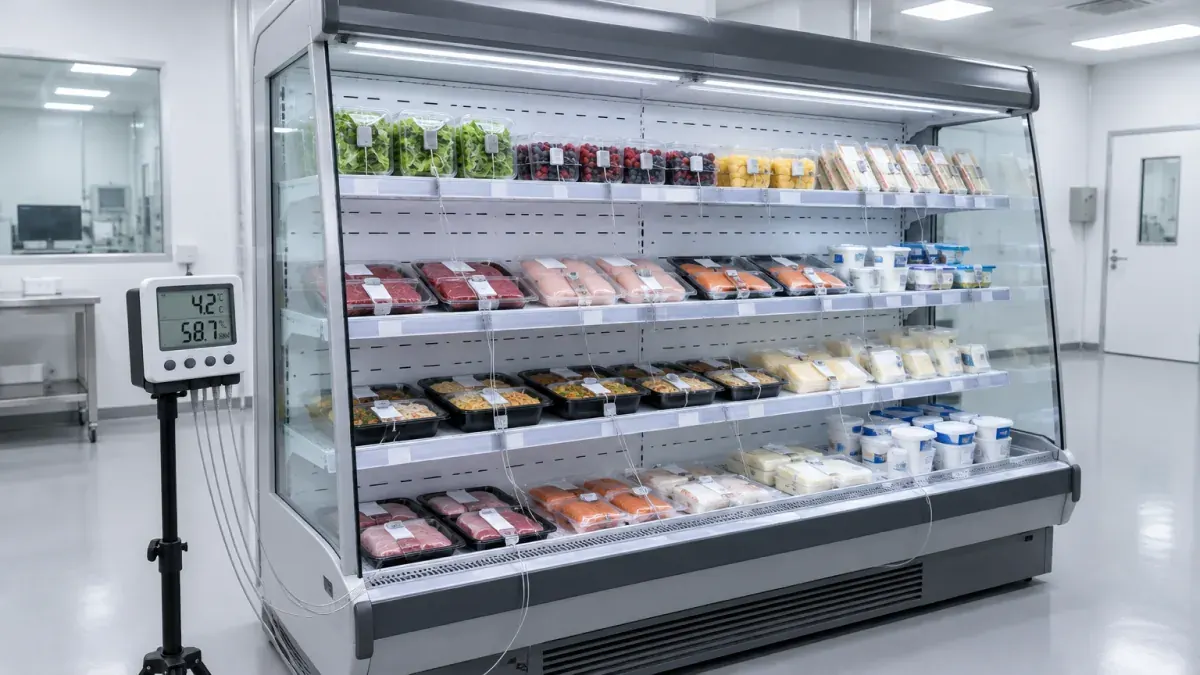
A good evaporator and air distribution system keeps every product position within the required temperature range, not just the probe location. Uniformity depends on coil size, fan selection, air ducting, shelf design and correct loading. Cabinets tested to EN ISO 23953 are assessed by measuring temperatures at many product positions, which gives a more meaningful picture than a single thermometer reading.

When choosing a display cabinet, consider the type of products (wrapped or unwrapped), the required temperature class and the store conditions. In daily use, respect the load lines, keep grilles clear and make sure defrost is working so the evaporator can do its job.

Start a request ← All articles

Home / Blog
27.10.2026 · 4 min read

Defrost Methods: Off-Cycle, Electric and Hot Gas

Why frost forms on evaporators and how off-cycle, electric and hot gas defrost remove it, including termination, drainage and defrost frequency.

Defrost Methods: Off-Cycle, Electric and Hot Gas

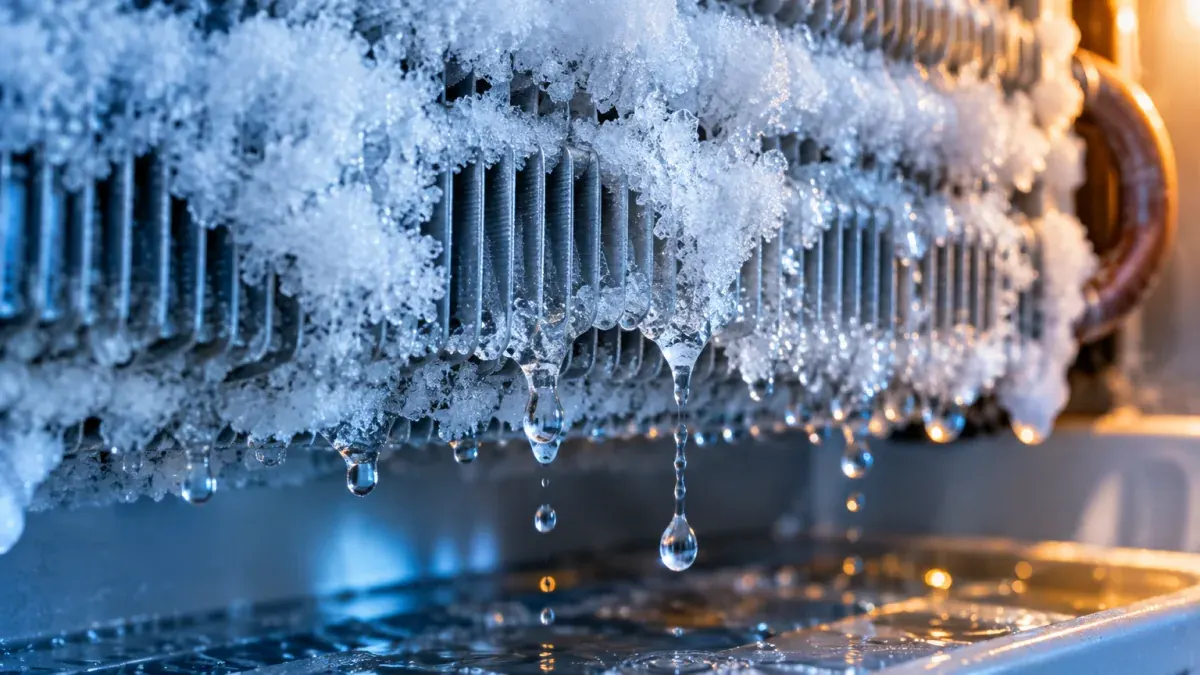
Any evaporator running below 0 °C will collect frost. A thin layer is normal, but if it is allowed to build up it blocks airflow, reduces cooling capacity and can eventually turn the coil into a block of ice. Defrosting removes this frost at regular intervals. The method used depends mainly on the cabinet's operating temperature and the type of system.

Why frost forms

Store air contains water vapour. When this air passes over an evaporator surface colder than the dew point, moisture condenses; if the surface is below 0 °C, it freezes as frost. The amount of frost depends on store humidity, how often doors are opened, how much warm air enters an open cabinet, the coil temperature and the products themselves. Unwrapped fresh products also release moisture.

The three main defrost methods

Off-cycle defrost

Off-cycle defrost is the simplest method. The compressor (or the refrigerant supply in remote systems) is stopped while the evaporator fans keep running. Cabinet air, which is above 0 °C, passes over the coil and melts the frost.

  • Suitable for medium-temperature cabinets with air temperatures of roughly +1 °C and above, such as dairy, drinks and fresh produce multidecks.
  • Uses no extra energy for heating.
  • Not suitable for freezers, because the cabinet air is far below freezing.

Electric defrost

Electric defrost uses resistance heaters fitted in or on the evaporator coil and often in the drip tray and drain. During defrost the refrigeration stops, the evaporator fans usually stop to keep heat away from the products, and the heaters are switched on.

  • The standard method for most plug-in freezers and low-temperature remote cabinets.
  • Simple to control and reliable.
  • Uses electrical energy and adds some heat to the cabinet, so defrosts should be no longer or more frequent than necessary.

Hot gas defrost

Hot gas defrost sends hot discharge vapour from the compressor through the evaporator, warming the coil from inside. It melts frost quickly and evenly and uses heat that the system already produces rather than extra electricity. In plug-in units this is usually done with a solenoid valve that bypasses the condenser; in remote and central systems it requires extra pipework and valves, and enough other evaporators running to supply hot gas. It is more complex to design and must be managed carefully to avoid liquid returning to the compressor at the end of defrost.

Defrost termination and drainage

Defrost should end as soon as the coil is clear. Common termination methods are:

  • Temperature termination: an evaporator probe ends defrost when the coil reaches a set temperature, for example a few degrees above 0 °C.
  • Time termination: a maximum duration acts as a safety limit if the probe fails or the coil does not warm up.

After defrost, a drip time lets water drain away before refrigeration restarts, and a fan delay keeps evaporator fans off until the coil is cold again, so water droplets are not blown into the cabinet and warm air is not pushed onto products.

Meltwater runs into a drip tray and through a drain, which is often heated in freezers so that it does not refreeze. In plug-in cabinets the water usually goes to an evaporation tray near the compressor or condenser, where heat from the hot gas line or an electric heater evaporates it. Remote cabinets are normally connected to the store drainage with a trap.

How often to defrost

Defrost frequency is set according to cabinet type and conditions. Medium-temperature open cabinets may defrost several times a day; glass-door freezers in a dry store may need fewer defrosts. Some controllers use adaptive or demand defrost, starting defrost only when needed. Signs that settings need review include ice on the coil, water leaks, frost on products and temperature rises after defrost.

When choosing a cabinet, check the defrost type in the technical data and match it to the application. FROSTECH, for example, lists the defrost type (off-cycle, electric or hot gas) and climate class in each model's technical data, which makes it easier to compare cabinets and plan maintenance.

Start a request ← All articles

Home / Blog
27.10.2026 · 3 min read

Plug-in vs Remote Refrigeration: Which Is Right for Your Store?

A practical comparison of plug-in and remote display cabinets covering heat, installation, flexibility, noise, energy use and maintenance.

Plug-in vs Remote Refrigeration: Which Is Right for Your Store?

One of the first decisions in planning a store's refrigeration is whether to use plug-in cabinets, remote cabinets connected to a central system, or a combination. Both approaches are well proven. The right choice depends on the size of the store, the building, the budget and how the layout may change in future.

Definitions

A plug-in (self-contained or integral) cabinet has its compressor, condenser, evaporator and controls built in. It only needs a power socket and, in some cases, a drain connection.

A remote cabinet contains the evaporator, expansion device, fans and controls, but not the compressor or condenser. It is connected by refrigerant pipes to a condensing unit or a central compressor rack, usually located in a plant room, yard or on the roof.

Where the heat goes

This is the most important difference. A plug-in cabinet rejects all of its heat, including the compressor's energy, into the store. In winter this can help heat the building; in summer it adds to the air conditioning load and can make the sales area uncomfortably warm if many cabinets are installed. A remote system rejects heat outside the sales area, and larger central systems can recover that heat for space or water heating.

Comparing the two

  • Installation: plug-in cabinets can be installed quickly with no refrigeration pipework. Remote systems require design, piping, pressure testing, evacuation and commissioning by qualified contractors.
  • Flexibility: plug-ins can be moved, added or removed as the layout changes. Remote cabinets are tied to their pipework.
  • Noise: plug-ins produce compressor and fan noise in the store. Remote cabinets are quieter at the point of sale because the compressors are elsewhere.
  • Energy: a well-designed central system can be very efficient, particularly with variable-speed compressors, electronic expansion valves and heat recovery. Modern plug-ins with natural refrigerants, efficient compressors and EC fans are also efficient, but the store may spend extra energy removing their heat in warm weather.
  • Refrigerant: plug-ins use small charges in sealed circuits, often hydrocarbons such as R290. Remote systems hold much larger charges across long pipe runs, so leak prevention and detection are especially important.
  • Maintenance and resilience: if one plug-in fails, only that cabinet is affected and it can be swapped. A central system failure can affect many cabinets at once, although racks normally have several compressors for redundancy.
  • Cost: plug-ins usually have lower upfront project costs; remote systems involve higher initial investment but may offer lower running costs in large stores.

When each fits

Plug-in cabinets generally suit:

  • convenience stores, small supermarkets and petrol station shops;
  • rented or temporary premises, and stores that change layout frequently;
  • promotional or seasonal displays;
  • buildings where there is no space or permission for external plant.

Remote systems generally suit:

  • large supermarkets and hypermarkets with long runs of cabinets;
  • stores where noise and heat in the sales area must be minimised;
  • projects planning heat recovery or central monitoring.

Mixed solutions

Many stores combine both. Long runs of multidecks and freezers may be connected to a central system, while plug-in cabinets are used for drinks, promotions or areas that are likely to change. Another option is plug-in cabinets with water-cooled condensers connected to a water loop, which keeps the flexibility of plug-ins while taking the heat outside.

Before deciding, consider the store's size, ventilation and air conditioning capacity, the availability of skilled contractors and the expected life of the layout. A supplier that offers both plug-in and remote models can help you compare the options for your specific project.

Start a request ← All articles

Home / Blog
26.10.2026 · 4 min read

Thermostats and Digital Controllers

How mechanical thermostats and electronic controllers manage display cabinets: probes, setpoint, differential, defrost settings, alarms and HACCP logging.

Thermostats and Digital Controllers

The controller decides when a refrigeration system runs, when it rests and when it defrosts. In older and simpler equipment this is a mechanical thermostat; in most modern display cabinets it is a digital electronic controller. Understanding the main settings helps owners and technicians keep products at the right temperature without wasting energy.

Mechanical thermostats

A mechanical thermostat uses a sensing bulb and capillary filled with a gas or liquid. As temperature changes, the fill expands or contracts and moves a bellows or diaphragm that opens and closes electrical contacts to switch the compressor. A dial sets the temperature.

  • Advantages: simple, inexpensive, no electronics.
  • Limitations: limited accuracy, no display of actual temperature, no alarms or data logging, and defrost must be handled by a separate timer.

Electronic controllers

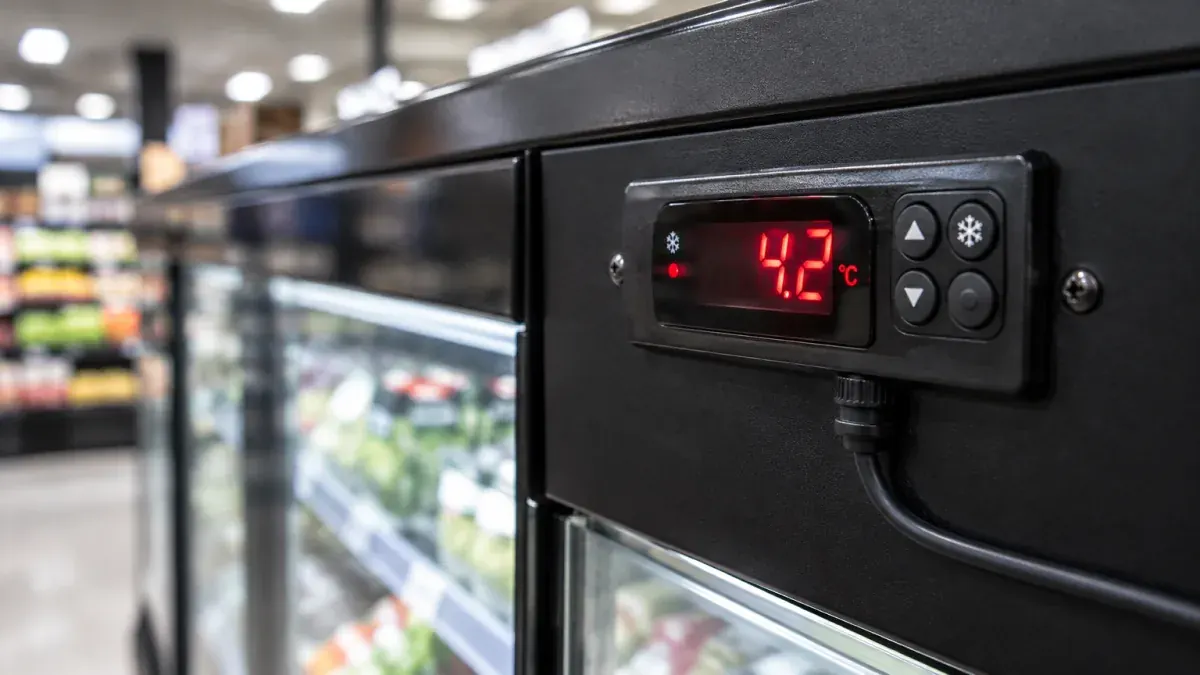
A digital controller reads one or more temperature probes, usually NTC or PTC thermistors, and switches outputs through relays: compressor (or liquid line solenoid valve in remote systems), evaporator fans, defrost heaters and sometimes lights or anti-condensation heaters. It displays temperature and allows parameters to be adjusted, often with password protection.

Probes

  • Air (regulation) probe: measures cabinet air, often in the return air or discharge air stream. Its position strongly influences what the display shows.
  • Evaporator probe: measures coil temperature to end defrost and to control fan delay after defrost.
  • Additional probes: a second air probe, a condenser probe for high-temperature alarms, or a product-simulating probe for monitoring.

Key settings

  • Setpoint: the target temperature at which the compressor stops.
  • Differential (hysteresis): how far the temperature must rise above the setpoint before the compressor restarts. Too small a differential causes short-cycling; too large allows wide temperature swings.
  • Minimum on and off times: protect the compressor from frequent starts.
  • Defrost interval: time between defrosts, or the schedule of defrost start times.
  • Defrost type: off-cycle, electric or hot gas, depending on the cabinet.
  • Defrost termination temperature and maximum duration: end defrost when the coil is clear, with a time limit as back-up.
  • Drip time and fan delay: allow water to drain and the coil to cool before fans restart.
  • Display lock during defrost: shows the last stable reading during defrost to avoid unnecessary concern.

Parameters should only be changed by trained staff, and the manufacturer's recommended values are a good starting point.

Alarms

Controllers can raise alarms for high or low temperature, probe failure, door left open, defrost ended by time rather than temperature, and high condensing temperature. A delay is usually applied so that short events such as defrost or restocking do not trigger alarms. Alarms are only useful if someone sees and acts on them, so local buzzers, display codes and remote notifications should be part of the store's procedures.

HACCP logging and remote monitoring

Food safety management systems based on HACCP principles require temperatures to be monitored and recorded. Many controllers store temperature history and alarm events, often called HACCP alarms, that can be read on the display or downloaded. Controllers with a serial interface, commonly using Modbus RS-485, or with wireless or cloud connectivity can be linked to a central monitoring system. This allows:

  • continuous temperature records for inspections;
  • alarm notifications by message or email outside opening hours;
  • remote adjustment of parameters by authorised technicians;
  • trend analysis to detect gradual problems such as dirty condensers or failing fans.

When choosing display cabinets, check the type of controller, the probes fitted, whether alarms and HACCP data are available, and whether it can connect to the store's monitoring system. A capable controller is an inexpensive way to protect both stock and equipment.

Start a request ← All articles

Home / Blog
26.10.2026 · 4 min read

Fan Motors in Refrigeration: Shaded-Pole vs EC Motors

The role of condenser and evaporator fans, how shaded-pole and EC motors differ in efficiency, speed control and noise, and tips for replacement.

Fan Motors in Refrigeration: Shaded-Pole vs EC Motors

Fans are easy to overlook, but a display cabinet cannot work without them. Evaporator fans circulate cold air around the products, and condenser fans carry heat away from the condenser. Because evaporator fans often run almost continuously, their efficiency has a noticeable effect on a cabinet's energy use. The two motor types you will meet most often are shaded-pole and electronically commutated (EC) motors.

What the fans do

  • Evaporator fans draw air from the cabinet through the evaporator coil and blow it back, creating the air curtain in open multidecks and even air distribution in glass-door cabinets. The motor's own heat is released inside the cabinet, so the refrigeration system must remove it as well.
  • Condenser fans move store or outdoor air across the condenser. They typically run when the compressor runs, or are speed-controlled to hold condensing pressure.

Shaded-pole motors

The shaded-pole motor is a simple single-phase AC induction motor. A copper ring around part of each pole creates a delayed magnetic field that makes the rotor turn. It is cheap, compact and robust, which is why it has been used in refrigeration for decades. However, it has disadvantages:

  • low efficiency, often around 20 to 30 %, so most of the electrical input becomes heat;
  • fixed speed on a given supply, with limited control options;
  • higher motor temperatures, which can shorten bearing life.

EC motors

An EC motor is a brushless DC motor with permanent magnets and integrated electronics that convert the AC supply and control the motor windings. It can be fitted with the same type of fan blade and similar mountings as a shaded-pole motor.

  • Efficiency: typically 60 % or more, so the same airflow uses much less power. Less waste heat in the evaporator compartment also reduces the refrigeration load.
  • Speed control: many EC fans accept a control signal (such as 0–10 V or PWM) or have selectable speeds, so airflow can be matched to demand, for example lower speed at night or a variable condenser fan speed.
  • Noise: smoother operation and the ability to run slower usually make EC fans quieter.
  • Life: cooler running and good bearings help longevity.

The main drawback is higher purchase cost, which is usually recovered through lower energy use in cabinets where fans run many hours a year.

Energy impact

Evaporator fan power counts twice: once as electricity consumed by the motor, and again as heat that the compressor must remove from the cabinet. For this reason replacing shaded-pole evaporator fans with EC fans is one of the most common retrofit measures in supermarkets. The exact saving depends on fan size, running hours and the original motor, so it is best estimated for each case rather than assumed.

Replacement tips

Fan replacement should be carried out by a competent person with the power isolated. Points to check:

  • match the voltage, frequency, rotation direction and mounting arrangement;
  • match the airflow and blade diameter and pitch; a different blade can upset the air curtain or condenser performance;
  • check that the motor is suitable for the operating temperature, especially in freezers, and for humid or wet conditions;
  • for cabinets with flammable refrigerants such as R290, use components approved by the manufacturer that are suitable for that application;
  • check fan guards and clean the blades; a dirty or damaged blade reduces airflow and causes vibration;
  • listen for bearing noise and look for blades that rub on the shroud, which are early signs of failure.

When choosing new display cabinets, ask whether evaporator and condenser fans use EC motors and whether speed control is available. It is a modest detail on the specification sheet that affects energy consumption every hour the cabinet runs.

Start a request ← All articles

Home / Blog
25.10.2026 · 3 min read

Insulation and Why Thickness Matters

How polyurethane foam insulation works in display cabinets, the role of thermal conductivity and blowing agents, typical thicknesses and condensation control.

Insulation and Why Thickness Matters

Insulation is the silent part of a refrigerated cabinet. It does not move, make noise or show a reading, yet it determines how much heat leaks in from the store and therefore how hard the refrigeration system must work. Good insulation reduces energy use, keeps temperatures stable and prevents condensation on the outside of the cabinet.

Polyurethane foam

Almost all modern commercial cabinets and cold room panels use rigid polyurethane (PUR) foam, or its close relative polyisocyanurate (PIR). Two liquid components are mixed and injected between the inner and outer skins of the cabinet, where they expand and cure. The result is a rigid closed-cell foam that:

  • provides very good thermal insulation for its thickness;
  • bonds strongly to the metal or plastic skins, adding structural strength;
  • resists moisture absorption thanks to its closed-cell structure;
  • fills complex shapes without gaps when correctly injected.

Thermal conductivity

The performance of an insulating material is described by its thermal conductivity, often written as lambda (λ) and measured in W/m·K. The lower the value, the better the insulation. Rigid polyurethane foam typically has a thermal conductivity in the region of 0.020 to 0.025 W/m·K, much lower than materials such as mineral wool or expanded polystyrene of similar thickness.

The heat that passes through a wall depends on the conductivity, the area, the temperature difference and the thickness. Doubling the thickness roughly halves the heat flow through the insulation itself, although edges, door frames and other thermal bridges also contribute.

Blowing agents

The foam's cells are filled with a gas produced by the blowing agent. Older foams used CFCs and later HCFCs, both of which damage the ozone layer. Today, cyclopentane is widely used: it has zero ODP and very low GWP, and gives good insulation values. Because it is flammable, foaming plants require appropriate safety measures. Water-blown (CO2) and HFO-blown systems are also used.

Typical thicknesses

Insulation thickness is chosen according to the temperature difference between the cabinet and the store:

  • medium-temperature cabinets for chilled products typically use around 50 to 60 mm;
  • low-temperature cabinets and freezers often use around 60 to 80 mm, or more in some designs;
  • cold room panels may range from about 80 mm for chilled rooms to 120 mm or more for freezer rooms.

These are general figures; the actual thickness should be checked in each product's technical data.

Condensation and energy impact

If the outer surface of a cabinet becomes colder than the dew point of the store air, moisture condenses on it. This is unsightly, can make floors slippery and may lead to corrosion or mould. Adequate insulation keeps the outer skin close to room temperature. At weak points such as door frames, mullions and the edges of chest freezers, manufacturers may use perimeter heaters or heated profiles to prevent condensation, although improved designs try to reduce their use.

Heat conducted through the walls adds to the load from air infiltration, lighting, fans and products. While glass and open fronts often account for larger losses, insulation still matters, especially for freezers where the temperature difference is large. Thicker, well-made insulation helps to:

  • lower compressor running time and energy consumption;
  • keep product temperatures more stable during peak trading hours;
  • reduce external condensation and the need for anti-sweat heaters;
  • slow the temperature rise during power cuts.

Damage to insulation, for example from impacts that crack the skin and let in moisture, gradually reduces its performance. When comparing display cabinets, look at insulation thickness, the type of foam and blowing agent, and the quality of joints and door frames, as these details affect performance throughout the cabinet's life.

Start a request ← All articles

Home / Blog
25.10.2026 · 3 min read

Glass Doors: Double Glazing, Low-E and Anti-Fog

How glass doors cut display cabinet energy use, and what double and triple glazing, low-E coatings, argon fill, frame heaters and self-closing hinges do.

Glass Doors: Double Glazing, Low-E and Anti-Fog

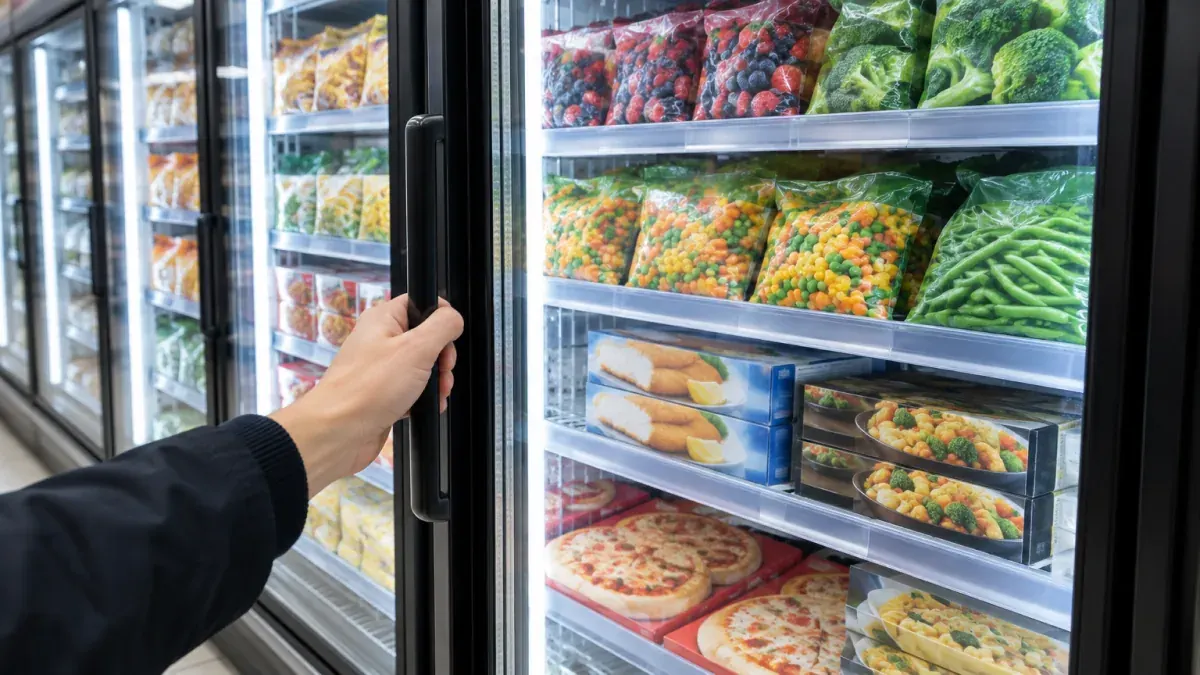
Adding doors to chilled and frozen display cabinets has become one of the most effective ways for supermarkets to reduce refrigeration energy. A well-designed glass door keeps cold air in and warm, humid store air out, while still giving customers a clear view of the products. The quality of the glass, frame and hinges determines how well this works in practice.

Energy savings compared with open cabinets

In an open multideck, the air curtain constantly mixes with store air. Warm air entering the cabinet must be cooled, and its moisture forms frost on the evaporator. Doors greatly reduce this infiltration. The benefits include:

  • a lower refrigeration load and less compressor running time;
  • less frost, so fewer or shorter defrosts are needed;
  • more stable product temperatures;
  • warmer, more comfortable aisles for customers and staff, and less load on store heating.

The actual saving depends on the cabinet, store conditions and how often doors are opened, so figures should come from tests or manufacturer data for the specific model.

Double and triple glazing

Doors use insulated glass units: two or three panes separated by a sealed spacer. The gap between panes greatly reduces heat conduction.

  • Double glazing is common for medium-temperature cabinets.
  • Triple glazing is often used for freezers, where the temperature difference is greater and the risk of condensation on the outer pane is higher.

Tempered (toughened) safety glass is normally used for strength and safety.

Low-E coatings and argon fill

A low-emissivity (low-E) coating is a microscopically thin metallic or metal-oxide layer applied to one of the internal glass surfaces. It reflects long-wave infrared (heat) radiation while allowing visible light through, reducing radiant heat transfer across the unit.

Filling the space between panes with argon, an inert gas that conducts heat less than air, further improves insulation. Together, low-E coatings and argon fill can significantly lower the heat transfer coefficient (U-value) of the glass unit.

Anti-fog: frame heaters and heaterless doors

When a door is opened, warm, humid store air meets cold glass and frame surfaces. If those surfaces are below the dew point, they fog or form condensation. Two approaches are used:

  • Heated doors: electric heaters in the frame, and sometimes a conductive heated coating on the glass, keep surfaces above the dew point. They are effective in humid stores but consume energy and add heat to the cabinet. Some controllers adjust heater power according to store humidity.
  • Heaterless doors: improved insulation, low-E coatings and gas fill keep the outer pane warm enough without heaters. Fogging on the inner pane after opening clears quickly as the cabinet recovers. Their suitability depends on store humidity and the cabinet's climate class.

Hinges, seals and lighting

Doors only save energy when they are closed. Self-closing hinges, often with a hold-open position for restocking and soft-close damping, ensure doors return after customers take a product. Magnetic gaskets seal the door against the frame; they should be cleaned regularly and replaced if torn or flattened.

LED lighting, usually mounted in the door mullions or frame, lights the products evenly while producing much less heat than fluorescent tubes. Because LEDs work efficiently at low temperatures, they are well suited to freezers.

When choosing glass-door cabinets, check the number of panes, the use of low-E coatings and gas fill, whether frame or glass heaters are needed, the hinge type and the climate class the cabinet is tested for. In daily use, keep gaskets clean, check that doors close fully and train staff to keep doors shut during restocking whenever possible.

Start a request ← All articles

Home / Blog
24.10.2026 · 4 min read

Climate Classes and Temperature Classes Explained

How EN ISO 23953 climate classes and product temperature classes such as M1, M2, H1 and L1 work, and how to read them on a display cabinet spec sheet.

Climate Classes and Temperature Classes Explained

Display cabinet specification sheets often include codes such as "climate class 3" and "M1" or "L1". These come from the international standard EN ISO 23953, which defines how refrigerated display cabinets are tested. Understanding these codes helps you compare cabinets fairly and choose equipment that will perform in your store.

Why test conditions matter

The performance of a display cabinet depends heavily on the air around it. A cabinet that holds products comfortably in a cool, dry room may struggle in a warm, humid one, because more heat and moisture enter the cabinet. EN ISO 23953 therefore specifies standard test-room conditions, called climate classes, and requires cabinets to keep simulated products (test packages) within defined temperature limits under those conditions.

Climate classes

Each climate class is defined by a dry-bulb temperature and relative humidity in the test room. The most commonly quoted classes include:

  • Climate class 0: 20 °C and 50 % RH.
  • Climate class 1: 16 °C and 80 % RH.
  • Climate class 2: 22 °C and 65 % RH.
  • Climate class 3: 25 °C and 60 % RH.
  • Climate class 4: 30 °C and 55 % RH.
  • Climate class 5: 27 °C and 70 % RH.

Climate class 3 is the most widely used reference for supermarket equipment, as it represents typical conditions in an air-conditioned or well-ventilated store. Higher classes represent warmer or more humid environments. A cabinet tested to class 3 can be expected to perform as rated in conditions up to 25 °C and 60 % RH; in hotter or more humid stores, performance may fall, and a cabinet rated for a higher class may be needed.

Product temperature classes

The temperature class states the range within which the test packages must stay during the test. Common classes are:

  • M2: −1 °C to +7 °C. Typical for many chilled products such as dairy and drinks.
  • M1: −1 °C to +5 °C. Used for more sensitive chilled products such as meat and some dairy.
  • H1: +1 °C to +10 °C.
  • H2: −1 °C to +10 °C.
  • L1: warmest pack −15 °C or colder, coldest −18 °C or colder. Used for frozen food and ice cream.
  • L2: warmest pack −12 °C or colder, coldest −18 °C or colder.

For frozen ranges, the coldest test package must be −18 °C or colder, while the warmest must not rise above the stated value. Other classes exist for specific applications.

How to read a specification sheet

A rating is usually written as a combination, for example "M1 / climate class 3" or "3M1". This means test packages stayed within −1 °C to +5 °C in a test room at 25 °C and 60 % RH. When comparing cabinets, check:

  • that the climate class matches, or exceeds, the expected conditions in your store, including summer peaks;
  • that the temperature class matches the products you plan to display;
  • that energy consumption figures are stated for the same climate and temperature classes, otherwise they cannot be compared fairly;
  • details such as cabinet dimensions, display area and whether night covers or doors were used in testing.

Limits of the rating

Test results are obtained in controlled conditions with standard loading. In a real store, draughts from doors or air conditioning, direct sunlight, overloading or blocked air grilles can reduce performance. The rating is a reliable basis for comparison, but correct installation and use are still essential.

When selecting commercial refrigeration equipment, treat the climate class and temperature class as key specifications. FROSTECH, for example, lists the climate class in each model's technical data; its cabinets are rated for climate class 3 (25 °C / 60 % RH), which helps buyers match equipment to their store conditions.

Start a request ← All articles

Home / Blog
24.10.2026 · 3 min read

10 Ways to Cut Refrigeration Energy Costs in a Supermarket

Ten practical measures to reduce supermarket refrigeration energy use, from doors and night curtains to EC fans, clean condensers and good maintenance.

10 Ways to Cut Refrigeration Energy Costs in a Supermarket

Refrigeration is often one of the largest consumers of electricity in a supermarket, running day and night throughout the year. The good news is that many savings come from simple, practical measures rather than major investment. The ten steps below combine equipment choices with everyday habits that store teams can adopt straight away.

Reduce the heat entering the cabinets

  • 1. Fit doors or use night curtains. Glass doors on chilled and frozen cabinets greatly reduce the infiltration of warm store air. For open multidecks, night blinds or curtains pulled down outside trading hours reduce losses when the store is closed.
  • 2. Keep air curtains clear. In open cabinets, never block the discharge or return air grilles with products, price strips or signs. A disturbed air curtain lets warm, humid air in, increasing load and frost.
  • 3. Respect the load lines. Products stacked above the load line or beyond the shelf edge sit outside the cold air and disrupt airflow. Correct loading keeps products cold and lets the cabinet work as designed.
  • 4. Check door seals and closing. Torn, flattened or dirty gaskets and doors that do not close fully let cold air escape. Inspect them regularly and make sure self-closing hinges are working.

Use efficient components

  • 5. Switch to LED lighting. LEDs use less energy than fluorescent tubes and release much less heat into the cabinet, reducing the refrigeration load as well as the lighting bill. Consider dimming or switching off lights outside trading hours where appropriate.
  • 6. Use EC fan motors. Electronically commutated motors are considerably more efficient than shaded-pole motors. Because evaporator fans run almost continuously and their heat must be removed by the refrigeration system, the saving counts twice.
  • 7. Consider variable-speed compressors. Inverter-driven compressors match capacity to the actual load, reducing on-off cycling and improving part-load efficiency, which is how most systems operate most of the time.

Set and maintain correctly

  • 8. Use the correct setpoints. Running a cabinet colder than necessary wastes energy. Set temperatures according to the products and food-safety requirements, and review defrost settings so that defrosts are neither too frequent nor too long.
  • 9. Clean condensers regularly. Dust and grease on condenser coils raise condensing pressure and compressor power. Regular cleaning is one of the cheapest and most effective energy measures available.
  • 10. Plan preventive maintenance. Regular checks of refrigerant charge and leaks (by a qualified technician), fans, drains, probes and controllers keep systems running efficiently and catch faults before they waste energy or damage stock.

Think about heat in the store

Plug-in cabinets release their heat into the sales area. In summer, this adds to the air conditioning load; in winter, it can help heat the store. Plan the layout so that cabinets have enough space for air to reach their condensers, avoid placing them near heaters, entrances or in direct sunlight, and check that ventilation or air conditioning can handle the extra heat. Remote systems, which reject heat outside, may offer opportunities for heat recovery.

Measure and monitor

You cannot manage what you do not measure. Useful practices include:

  • recording cabinet temperatures and alarms through the controller or a monitoring system;
  • sub-metering refrigeration electricity where possible;
  • comparing energy use before and after changes;
  • training staff on loading, door discipline and reporting faults.

When choosing new equipment, compare energy consumption figures measured under the same test conditions, and look for features such as glass doors, LED lighting, EC fans, efficient compressors and natural refrigerants. Combined with good daily practice, these choices keep running costs under control throughout the life of the cabinets.

Start a request ← All articles

Home / Blog
23.10.2026 · 3 min read

Preventive Maintenance Checklist for Display Cabinets

A daily, weekly, monthly and yearly maintenance checklist for supermarket display cabinets, separating staff tasks from qualified technician work.

Preventive Maintenance Checklist for Display Cabinets

Preventive maintenance keeps display cabinets running efficiently, protects stock and extends equipment life. Many tasks can be done by trained store staff, while others must be carried out by a qualified refrigeration technician. The checklist below is a general guide; always follow the manufacturer's instructions for each model and isolate the power before any cleaning inside electrical or fan compartments.

Daily tasks

  • Check and record cabinet temperatures, at least at opening and closing, and compare them with the required range.
  • Check the controller display for alarms or error codes and report them.
  • Make sure products are within the load lines and that air grilles are not blocked.
  • Check that doors close fully and that night blinds, where fitted, are used outside trading hours.
  • Look for ice build-up on the evaporator area, water on the floor or unusual noises.
  • Wipe up spills promptly so they do not reach drains or grilles.

Weekly tasks

  • Clean shelves, inner surfaces and glass using mild, non-abrasive cleaning products approved for food areas.
  • Clean door gaskets and check them for tears, gaps or hardening.
  • Check that the drain is flowing and that the drip tray or evaporation tray is not overflowing.
  • Check lighting and replace failed lamps or report faulty LED strips.
  • Confirm that temperature records are complete and that probes or thermometers are in place.

Monthly tasks

  • Inspect the condenser and clean dust and debris with a soft brush or vacuum, with power isolated, or arrange cleaning by a technician. In dusty or busy locations this may be needed more often.
  • Remove and clean honeycomb air grilles and the base area beneath the bottom deck, following the manufacturer's procedure.
  • Check evaporator and condenser fans for noise, vibration or reduced airflow.
  • Check that the cabinet is level and that panels and covers are secure.
  • Check the space around plug-in cabinets for blocked ventilation openings.

Yearly (or six-monthly) technician service

A qualified refrigeration technician should carry out a full service at least once a year, and more often for critical or heavily used equipment. Typical tasks include:

  • refrigerant leak checks using appropriate methods, in line with local regulations, which may set specific inspection intervals depending on the system and refrigerant;
  • checking operating pressures, superheat and subcooling;
  • deep cleaning of condenser and evaporator coils;
  • checking compressor operation, current draw and protection devices;
  • inspecting electrical connections, cables, plugs and earthing, and tightening terminals;
  • testing defrost heaters, drain heaters and defrost termination;
  • checking and calibrating probes, and reviewing controller parameters and alarm settings;
  • checking door heaters, hinges and self-closing mechanisms;
  • recording all work in the equipment log.

Important safety note

Work on the refrigerant circuit, including adding or recovering refrigerant and brazing, must only be carried out by trained and certified technicians. This applies especially to systems using flammable refrigerants such as R290 and R600a, which require specific procedures, tools and ventilation. Store staff should never attempt to open the refrigerant circuit or bypass safety devices.

Keeping records

A simple log for each cabinet, listing temperature checks, cleaning, faults and technician visits, helps identify recurring problems, supports food-safety inspections and provides evidence for warranty claims. Digital controllers with HACCP logging and remote monitoring can automate much of this.

When choosing display cabinets, consider how easy they are to maintain: accessible condensers, removable grilles, clear controller displays and well-documented service instructions make it much more likely that maintenance will actually be done.

Start a request ← All articles

Home / Blog
23.10.2026 · 4 min read

Common Refrigeration Faults and Their Causes

Common display cabinet faults, from poor cooling and ice build-up to water leaks and short-cycling, with what owners can check and when to call a technician.

Common Refrigeration Faults and Their Causes

Most display cabinet problems give warning signs before they become serious. Recognising these symptoms and knowing their usual causes helps store staff react quickly, protect stock and give the technician useful information. This guide covers common faults, the simple checks an owner can make, and the point at which a qualified technician should take over.

Cabinet not cold enough

Possible causes include:

  • products loaded beyond the load line or blocking the air grilles;
  • a dirty or obstructed condenser, or a plug-in cabinet placed too close to a wall;
  • doors not closing, damaged gaskets or night blinds not used;
  • high store temperature or humidity, draughts or direct sunlight;
  • an iced evaporator, a failed evaporator fan or incorrect controller settings;
  • refrigerant leak, failing compressor or faulty expansion device.

Owner checks: confirm the setpoint, clear grilles, correct loading, check doors and seals, and see whether the condenser is visibly dirty and the fans are turning. If the problem continues, call a technician.

Ice and water problems

Ice build-up on the evaporator

Heavy ice usually means defrost is not working correctly or too much moisture is entering the cabinet. Causes include failed defrost heaters, a faulty evaporator probe, incorrect defrost settings, a blocked drain, doors left open, or high store humidity. A low refrigerant charge can also cause uneven icing. Staff can check that doors are closed and that defrost alarms are not shown; a technician should diagnose defrost and refrigerant issues. Do not chip ice off the coil with tools, as this can puncture the tubes.

Water leaks

  • A blocked or frozen drain, often caused by debris or a failed drain heater.
  • An overflowing evaporation tray in plug-in units, for example if its heater has failed or the defrost water volume is high.
  • A cabinet that is not level, so water does not reach the drain.
  • Condensation dripping from uninsulated pipes.

Owners can check levelling and remove visible debris from the drain area. Persistent leaks should be inspected by a technician.

Short-cycling and unusual noise

Compressor short-cycling

Short-cycling means the compressor starts and stops very frequently. It increases wear and energy use. Typical causes are a controller differential set too small, a badly positioned or faulty probe, an overheating compressor tripping on its overload, a dirty condenser causing high-pressure trips, or a low refrigerant charge causing low-pressure trips. Report the pattern to a technician; it is useful to note how long each run and stop lasts.

Unusual noise

  • Rattling or buzzing: loose panels, pipes touching or a fan blade rubbing.
  • Grinding or squealing: worn fan motor bearings.
  • Knocking from the compressor: possible internal damage or liquid return, which needs urgent attention.
  • Gurgling or hissing: often normal refrigerant flow, especially after start-up or defrost.

Condensation on glass

Fog or droplets on the outside of glass doors usually result from high store humidity, failed door or frame heaters, damaged glazing seals or a cabinet operating outside its climate class. Brief fogging on the inside after a door is opened is normal and should clear quickly. Owners can check store humidity, ventilation and whether doors close properly; heater and glass faults require a technician.

When to call a technician

Call a qualified technician if temperatures stay out of range after basic checks, if alarms persist, if you notice oil stains, burning smells or electrical trips, or if you suspect a refrigerant leak. Refrigerant handling, opening the circuit and electrical repairs must only be carried out by trained, certified personnel, particularly with flammable refrigerants such as R290 and R600a. Move stock to another cabinet if product temperatures cannot be maintained.

Choosing cabinets with clear controller alarms, accessible components and good service documentation makes troubleshooting faster and reduces stock losses when problems occur.

Start a request ← All articles

Home / Blog
22.10.2026 · 4 min read

Valves in a Refrigeration System and Their Function

An overview of solenoid, check, service, pressure regulating and safety valves in refrigeration systems, where they sit and how electronic control has changed them.

Valves in a Refrigeration System and Their Function

Besides the expansion device, a refrigeration system contains several valves that start and stop refrigerant flow, prevent reverse flow, allow service work, regulate pressures and protect against dangerous conditions. Small plug-in cabinets may contain very few valves, while remote and central systems use many. This article explains the main types and their roles.

Solenoid and check valves

Solenoid valves

A solenoid valve is an electrically operated on/off valve. When the coil is energised, a magnetic plunger lifts and the valve opens; when de-energised, it closes. Most refrigeration solenoid valves are normally closed.

  • Liquid line solenoid valve: in remote display cabinets, it is located before the expansion valve and is opened and closed by the cabinet controller to regulate temperature. It is also used for pump-down, where the compressor removes refrigerant from the evaporator before stopping.
  • Hot gas solenoid valve: opens to send hot discharge gas to the evaporator during hot gas defrost.
  • Suction solenoid valve: isolates an evaporator from the suction line, for example during defrost.

Check valves

A check (non-return) valve allows refrigerant to flow in one direction only. It is used to prevent liquid from migrating back to the compressor or condenser during the off cycle, to stop reverse flow in systems with several evaporators or condensers, and in hot gas defrost and heat recovery circuits. Check valves must be installed in the correct direction, indicated by an arrow on the body.

Service valves

Service valves give technicians access to the system for measuring pressures, charging, recovering refrigerant and isolating components.

  • Schrader (access) valves: small spring-loaded valves, similar to tyre valves, fitted to the suction and liquid or discharge lines. They allow gauges to be connected and should always have a sealed cap.
  • Ball valves: quarter-turn valves used to isolate sections of a system, such as a filter drier or a whole cabinet, with very low pressure drop when open.
  • Compressor service valves: mounted on the suction and discharge ports of larger compressors, with a back-seat position for gauge connection.

Pressure regulating valves

  • Evaporator pressure regulator (EPR): fitted in the suction line after an evaporator, it keeps the evaporating pressure from falling below a set value. This allows evaporators operating at different temperatures to share one compressor rack, and prevents excessive dehydration or freezing of products.
  • Condensing (head) pressure regulator: maintains a minimum condensing pressure in cold weather so that a thermostatic expansion valve has enough pressure difference to feed the evaporator. It may work by flooding the condenser with liquid and bypassing hot gas to the receiver.
  • Crankcase pressure regulator: limits suction pressure at the compressor during pull-down or after defrost to prevent motor overload.
  • Hot gas bypass valve: injects hot gas to the low side to limit capacity at low load.

Safety valves

A pressure relief (safety) valve opens if pressure rises above a set limit, protecting vessels such as receivers from rupture, for example in a fire. Relief valves on larger systems are usually piped to a safe location. They must be correctly rated, never blocked or adjusted, and inspected according to regulations. Pressure switches, which stop the compressor, provide an additional layer of protection.

How electronic control has changed valves

Electronic control has replaced many mechanical functions. An electronic expansion valve can close tightly, removing the need for a separate liquid line solenoid in many cabinets. Electronic evaporator pressure control and variable-speed compressors reduce the need for mechanical EPR valves. Variable-speed condenser fans and floating head pressure control, combined with electronic expansion valves, allow lower condensing pressures and energy savings. Controllers also log valve operation and alarms, making diagnosis easier.

When specifying remote cabinets or systems, check which valves are supplied with the cabinet and which must be provided by the installer, and make sure valve choices are compatible with the refrigerant and control system.

Start a request ← All articles

Home / Blog
22.10.2026 · 4 min read

Correct Storage Temperatures for Supermarket Food

Typical storage and display temperatures for chilled, fresh, frozen and deli products, the cold chain, and how to match cabinet types to products.

Correct Storage Temperatures for Supermarket Food

Keeping food at the correct temperature protects customers, reduces waste and helps stores comply with food-safety law. Different products need different conditions, and display cabinets are designed for specific temperature ranges. The figures below are general, widely used values; the legal requirements and product-specific instructions in your country always take priority.

Why temperature matters

Most food-spoilage and pathogenic bacteria multiply quickly at temperatures between about +5 °C and +60 °C. Chilling slows growth, and freezing stops it, although it does not kill most bacteria. Temperature also affects quality: too warm and products spoil early; too cold and some fresh produce suffers chilling injury, while chilled products may freeze. Manufacturers' labels such as "keep refrigerated at 0 to +4 °C" should always be followed.

Typical temperatures by product group

Chilled products

  • Fresh meat and poultry: typically around 0 to +4 °C, often towards the colder end.
  • Fresh fish: as close to 0 °C as possible, often displayed on ice.
  • Dairy products (milk, yoghurt, cheese): typically 0 to +4 °C, with some markets allowing up to around +5 to +8 °C for certain products.
  • Ready meals, cooked meats and sandwiches: generally 0 to +4 °C or as stated on the label.
  • Drinks: often +2 to +8 °C, mainly for quality and customer preference rather than safety.

Fresh fruit and vegetables

Produce has very varied needs. Leafy greens, many root vegetables and berries keep best cool, typically around +2 to +8 °C, with high relative humidity to prevent wilting. Tropical and subtropical produce such as bananas, tomatoes, cucumbers and some citrus fruit can suffer chilling injury and is usually kept warmer, around +10 to +14 °C, or at ambient temperature. Produce cabinets therefore often run warmer than dairy cabinets and may use misting or gentle airflow to maintain humidity.

Frozen food and ice cream

  • Frozen food: −18 °C or colder is the widely accepted standard for storage and display. Short, limited rises during defrost or loading are tolerated by many regulations, but the product core should remain at or below −18 °C.
  • Ice cream: storage is typically −18 °C or colder, often −20 to −25 °C in cold stores. In display freezers, around −20 °C is common, as it keeps texture firm while remaining suitable for serving.

Deli and serve-over counters

Serve-over counters for cooked meats, cheese, salads and fresh meat usually operate at around 0 to +4 °C for meat and fish, and slightly warmer, around +2 to +6 °C, for cheese and some deli items, according to product needs. Static or gently ventilated counters help limit drying of unwrapped products. Hot food counters must be kept hot, usually at +63 °C or above, depending on local rules.

The cold chain

A display cabinet is only one link in the cold chain, which runs from production through transport, storage, display and the customer's journey home. Good practice in store includes:

  • checking product temperatures at delivery and rejecting deliveries that are out of range;
  • moving chilled and frozen goods into storage quickly;
  • loading cabinets promptly and within the load lines;
  • never using display cabinets to cool warm products, as they are designed to maintain temperature, not to pull it down;
  • monitoring and recording temperatures and acting on alarms.

Matching cabinet type to product

Choose cabinets whose tested temperature class suits the products: M1 or similar classes for meat and sensitive chilled foods, M2 for dairy and drinks, higher classes for some produce, and L1 or similar for frozen food and ice cream. Consider island freezers or glass-door freezers for frozen products, multidecks or glass-door cabinets for chilled lines, and serve-over counters for deli and fresh counters. Always confirm the requirements of local food-safety authorities, and select equipment rated for your store's climate conditions.

Start a request ← All articles

FROSTECH

FROSTECH DIŞ TİCARET LİMİTED ŞİRKETİ

Address

Kırımlı OSB Mah. Muhsin Yazıcıoğlu Blv. No: 2 İç Kapı No: 1, Merkez / Aksaray – Türkiye

Contact

+90 552 566 26 66
WhatsApp
info@frostech.co

Products

FRENIX · VELIX · NORDIX · CRYOIX · LUMIX · CRIO · SOVA · ALPI · FREXO · POLA

© 2026 FROSTECH · Since 1990Track shipment · Store planner · 3D container loader · Cooling load calculator · Proforma invoice · Become a distributor · Blog · Catalogues & Downloads · Privacy
Comparing: Compare now
Sales & quotes
WhatsApp+90 552 566 26 66info@frostech.coRequest a Quote